WHY WE
DESIGN
We are not building buildings.
We are building the immune system of the city.
The Era of Metabolic Urbanism
We are leaving the age of “Static Architecture” and entering the age of Metabolic Urbanism. Physical space is the last major domain that resists full centralization, and that friction is exactly where architecture has the greatest impact.
For three decades, our software improved while our cities kept underperforming. Housing became less affordable, congestion intensified, and buildings still overheat. Construction remains the only major sector with negative productivity growth since 1947.
Why? Because computation was mostly used to generate complex shapes, not to solve systemic problems. Interior design often optimizes the room while ignoring structure; architecture often optimizes the building while ignoring urban behavior. Fraktal exists to reconnect those broken links and turn isolated decisions into one continuous design intelligence.
Cities are Organisms
Traffic is circulation.
Data is the nervous system.
Energy is metabolism.
A city is not a machine. It is a forest: messy, redundant, and resilient.
Architecture is Biology
Facades breathe. Structures adapt.
Spaces evolve with their inhabitants.
In nature, a leaf is structure, skin, and energy factory all at once.
Design is Behavior
How do people move?
Where do they gather?
What patterns emerge?
The logic that governs a joint governs a city.
The Multi-Scale Journey
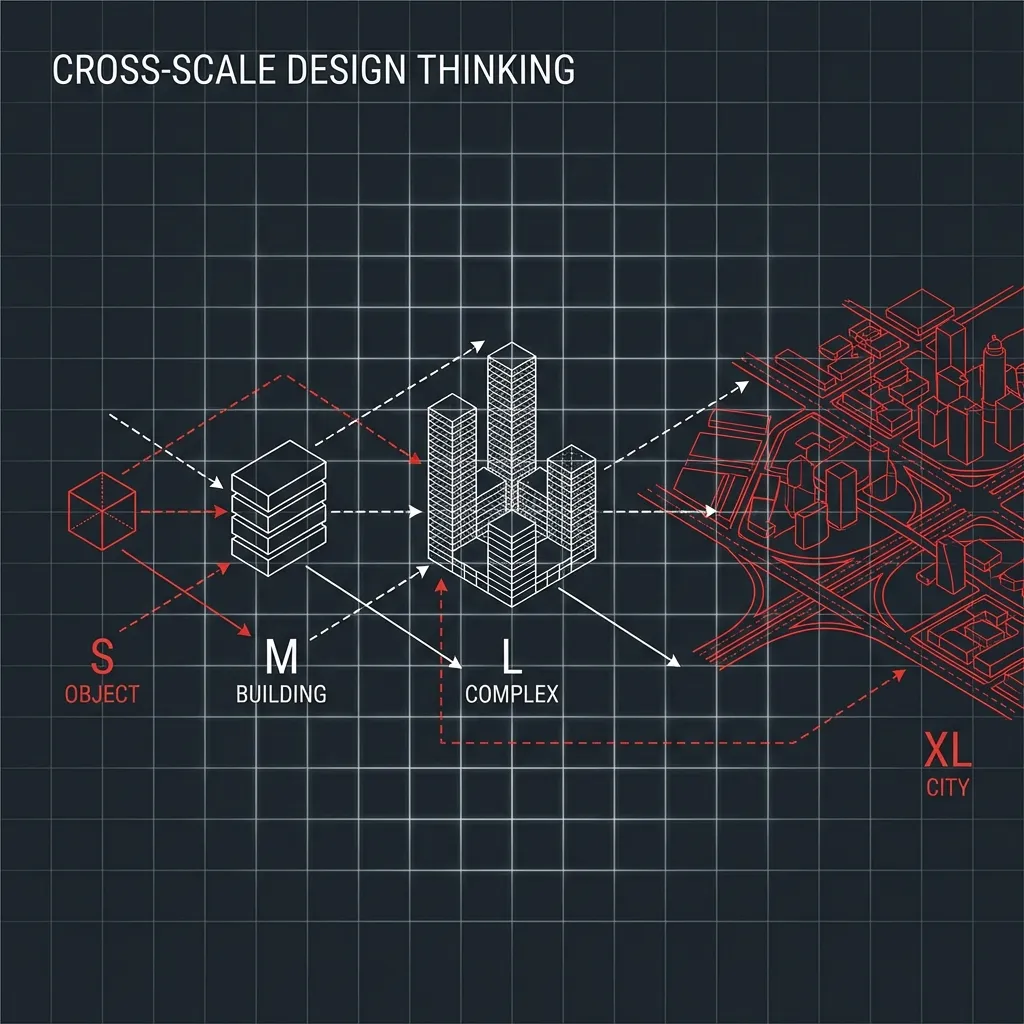
From furniture to city, from the intimate to the infinite. We treat design as a fractal continuity where every scale influences the next.
This is not a linear progression; it is a recursive loop.
Fractal continuity: eight scales from intimate to infinite
FURNITURE
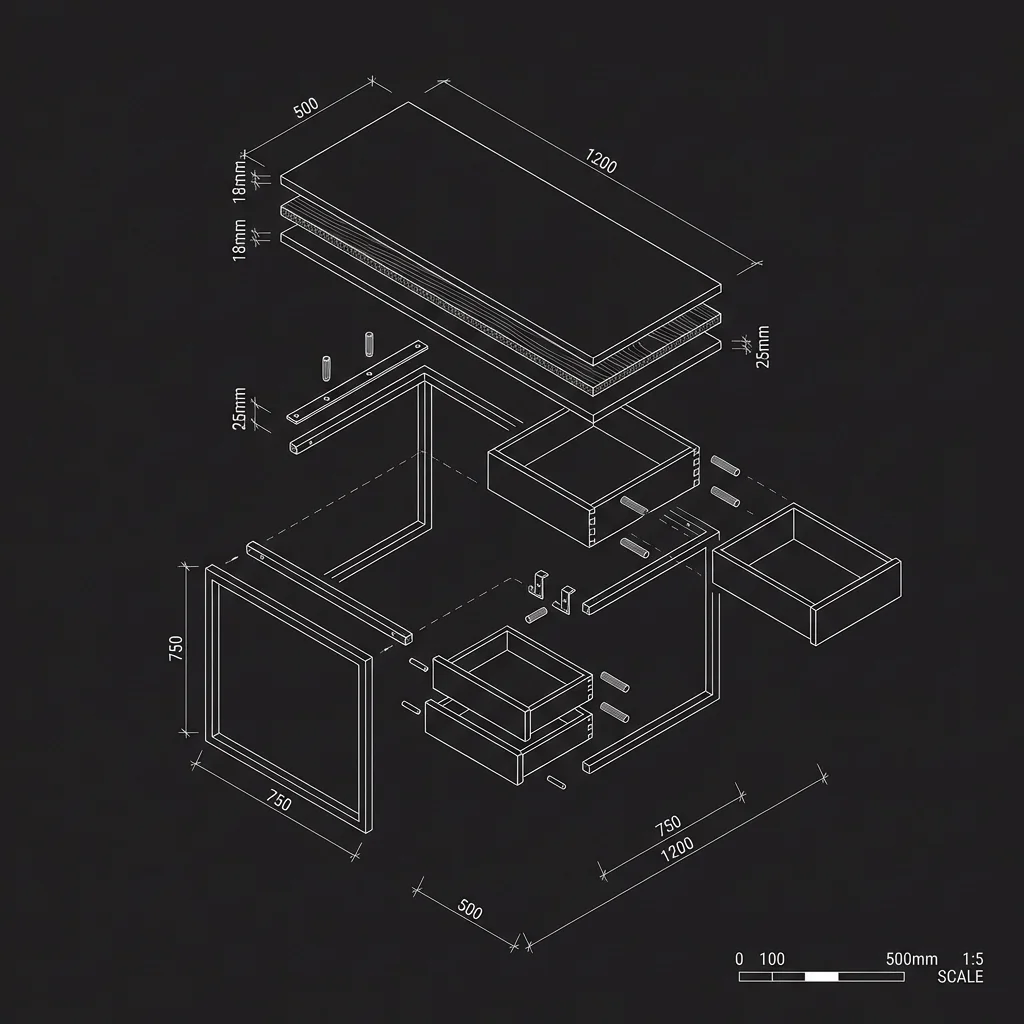
Furniture is where our scale begins: the smallest unit, where the ritual of making starts. Every millimeter matters. Following Semper and Frei Otto, we treat the joint as intelligence, not decoration: the point where material logic becomes spatial language.
We map force paths through the object so geometry is born from structure, not style. The joint is where a building starts in miniature.
The joint is where material logic becomes spatial language.
Every chair is a building in miniature.
ROOM
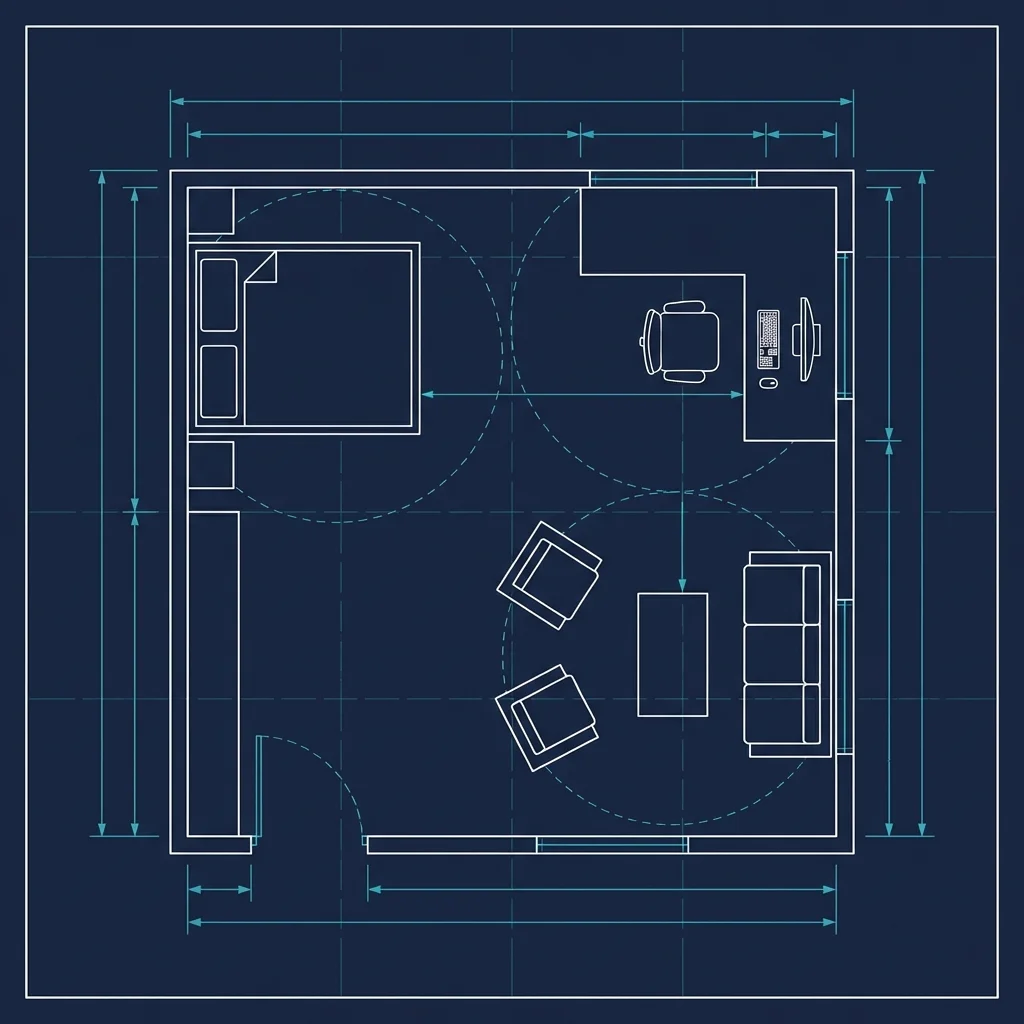
Edward Hall and Jan Gehl showed that behavior is measurable. We model the room as a dynamic field: light, airflow, privacy, and the probability of encounter. Space shapes behavior; we design not just walls but the conditions for interaction, focus, and rest.
We test layout alternatives against comfort and social-use scenarios. The output is a ranked set of options (comfort, privacy, natural light) before form is finalized.
Space shapes behavior.
We design the probability of interaction, focus, and rest within the room.
APARTMENT
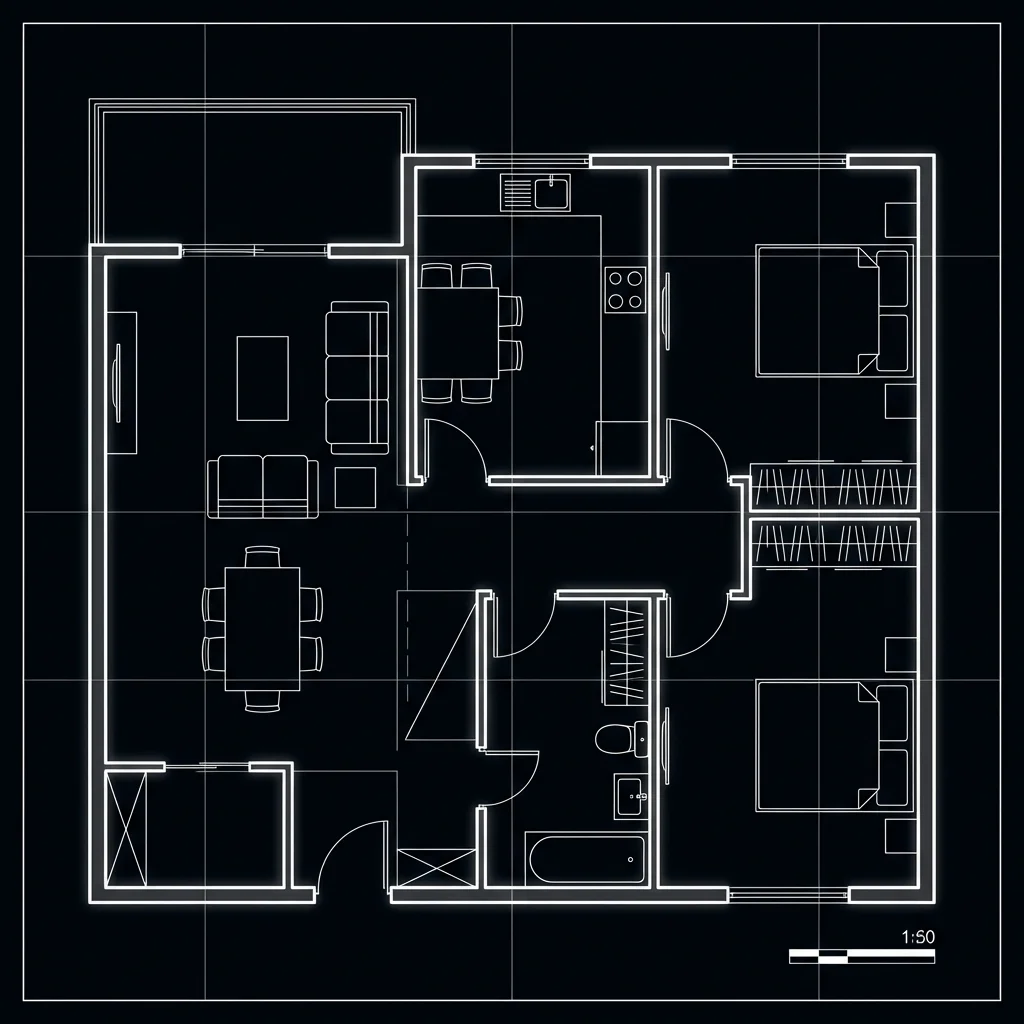
The apartment is the social atom of the city: privacy vs community, efficiency vs dignity. From Robin Evans to Habraken, we read the plan as a political diagram. Fraktal generates and evaluates unit topologies for flexibility, daylight depth, and threshold quality.
We treat the floor plan as a graph problem. Rooms are nodes, doors are edges. The algorithm generates hundreds of valid topologies, then filters them by daylight depth, circulation efficiency, and adaptive reuse potential. The architect picks from the top-scoring set.
The unit is a tiny city.
Each room behaves like a cell in a larger living system.
BUILDING
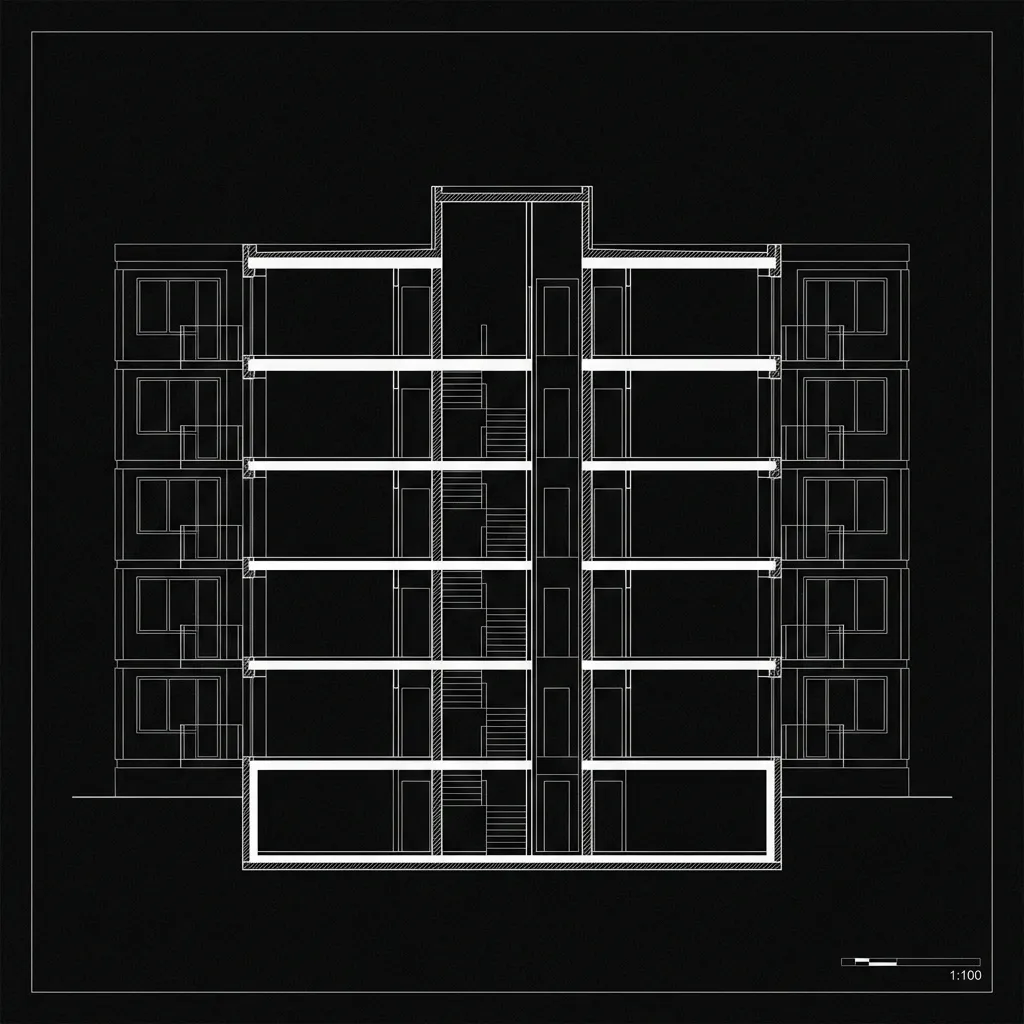
Buildings are assemblies of conflicting lifespans: frame, skin, services, and use patterns. We run multi-objective simulation stacks to map Pareto frontiers across energy, carbon, comfort, cost, and constructability so design teams choose consciously, not blindly.
Every building project at Fraktal runs through a multi-objective solver. We map the full Pareto frontier across energy, carbon, comfort, and cost. The design team sees the trade-offs visually and picks the sweet spot rather than guessing at it.
The building is an environmental interface.
Performance is measured in energy, comfort, adaptability, and social value.
COMPLEX
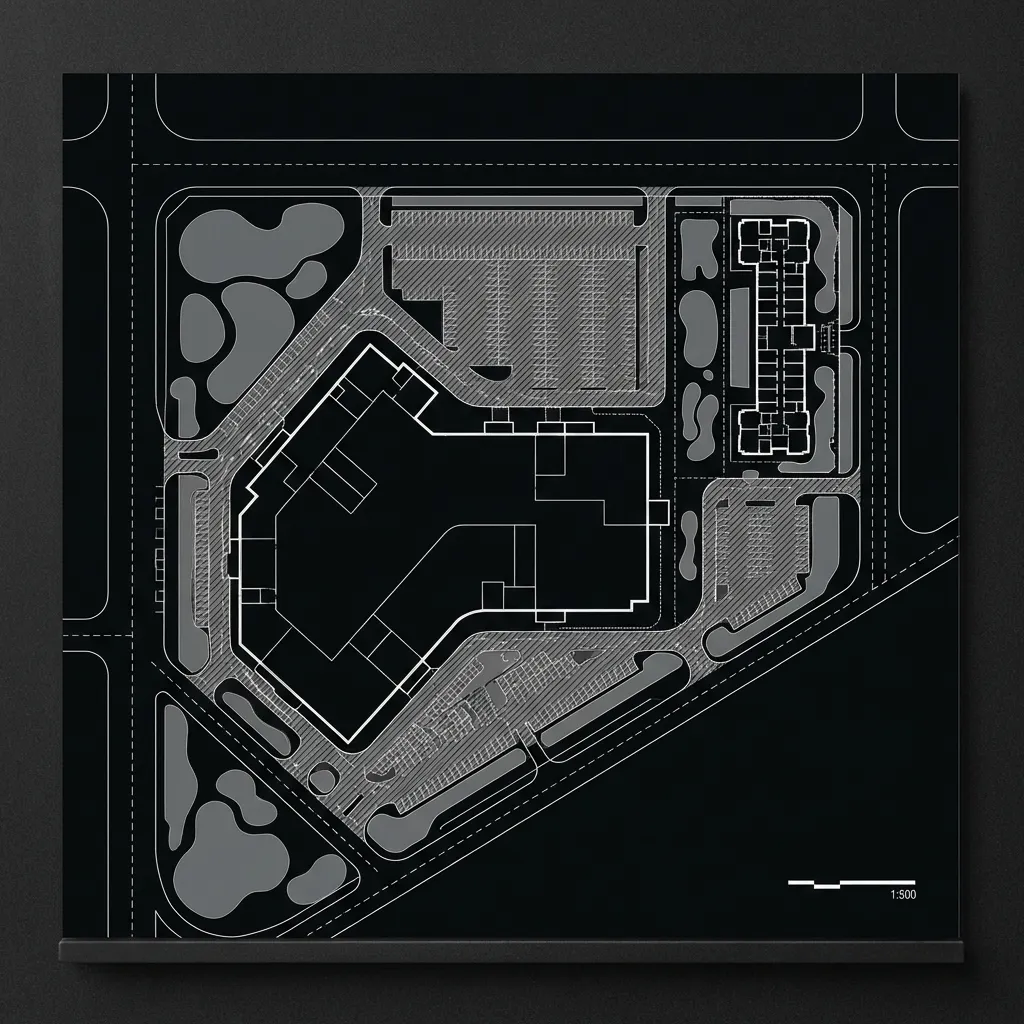
Most developments fail at this scale by repeating a single block logic. Inspired by Christopher Alexander and contemporary emergence theory, we use agent-based massing where buildings negotiate sunlight, view corridors, wind channels, and public access as an ecosystem.
We assign each building an autonomous agent that negotiates sunlight access, view quality, and wind protection with its neighbors. The massing emerges from these negotiations, producing organic variety rather than copy-paste repetition.
The whole exceeds the sum of parts.
Urban texture emerges from negotiated difference, not uniform repetition.
DISTRICT
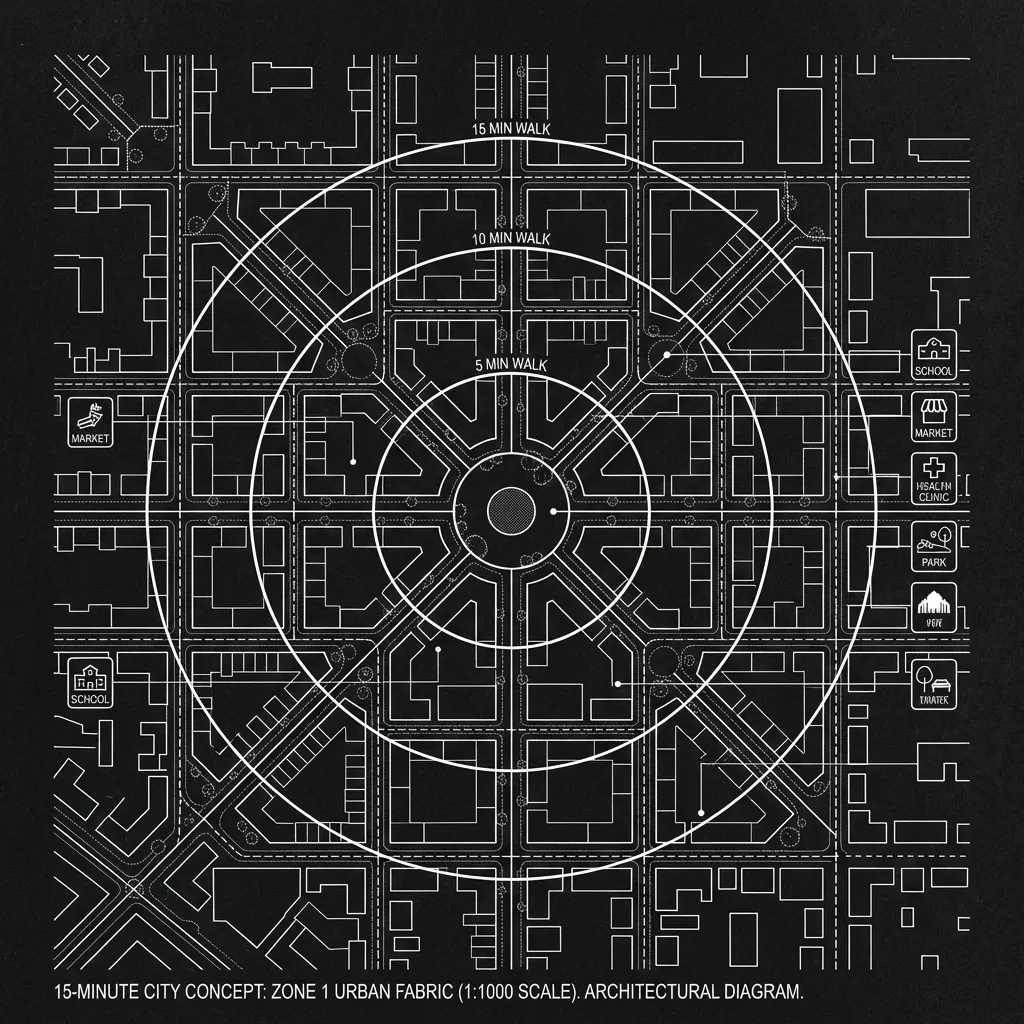
From Hillier's Space Syntax to Jane Jacobs' street intelligence, network structure predicts movement, safety, and local vitality. We diagnose where districts fail, then test interventions that improve walkability, mixed use intensity, and social overlap.
We run Space Syntax analysis on the existing street network to find dead zones and high-centrality corridors. Proposed interventions are tested against walkability scores and pedestrian flow simulations before any physical change.
Urban tissue is not static layout; it is social negotiation made spatial.
CITY
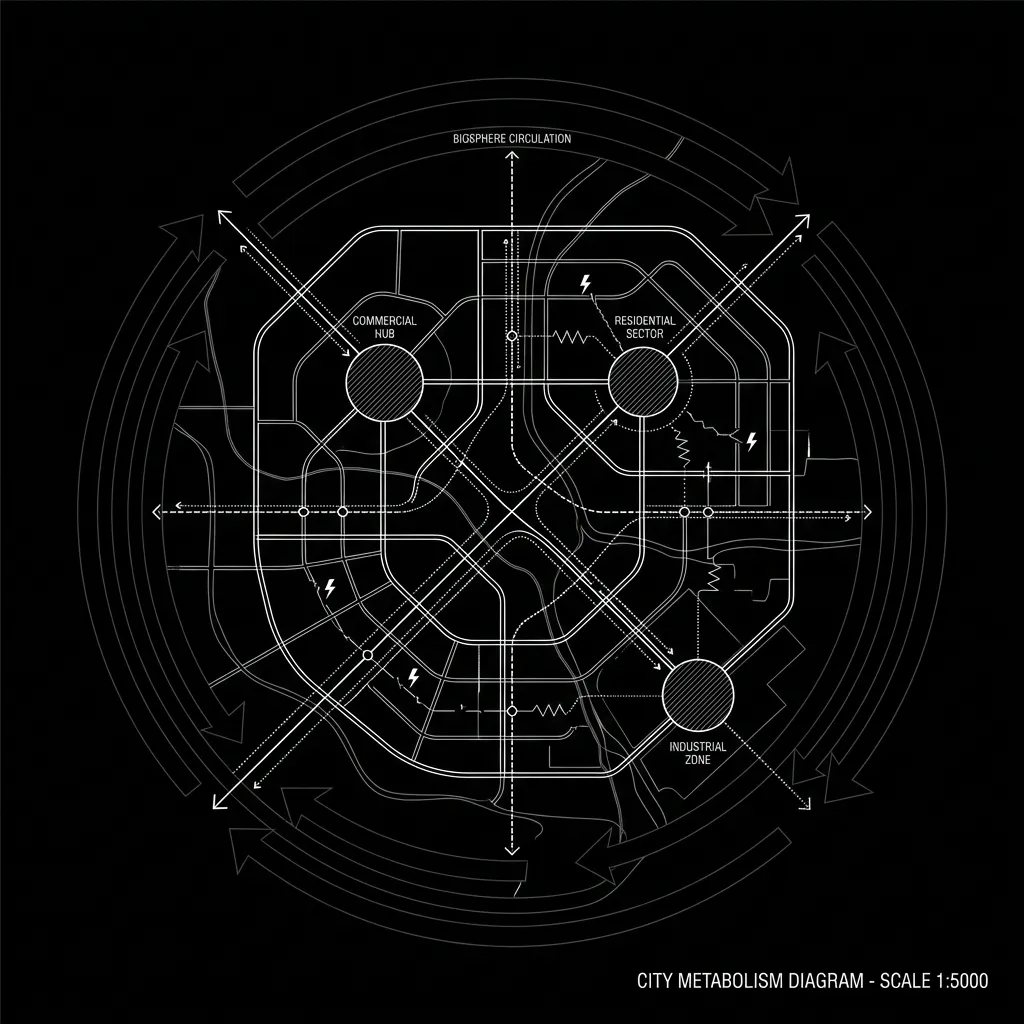
The city is a metabolism of flows: mobility, energy, water, waste, and information. Metropolis is not a neutral container; it is the arena where industrial, social, and ecological forces compete for spatial dominance. Building on Bettencourt's scaling laws, we model non-linear urban behavior to locate intervention points where small spatial changes produce system-level gains.
We build agent-based city models that track mobility, energy, water, and information flows simultaneously. The simulation reveals tipping points: locations where a single spatial move (a new crossing, a reclaimed lane, a green corridor) cascades through the entire system.
The city is a strange attractor: apparently chaotic, but governed by deep recursive patterns and feedback loops.
TIME
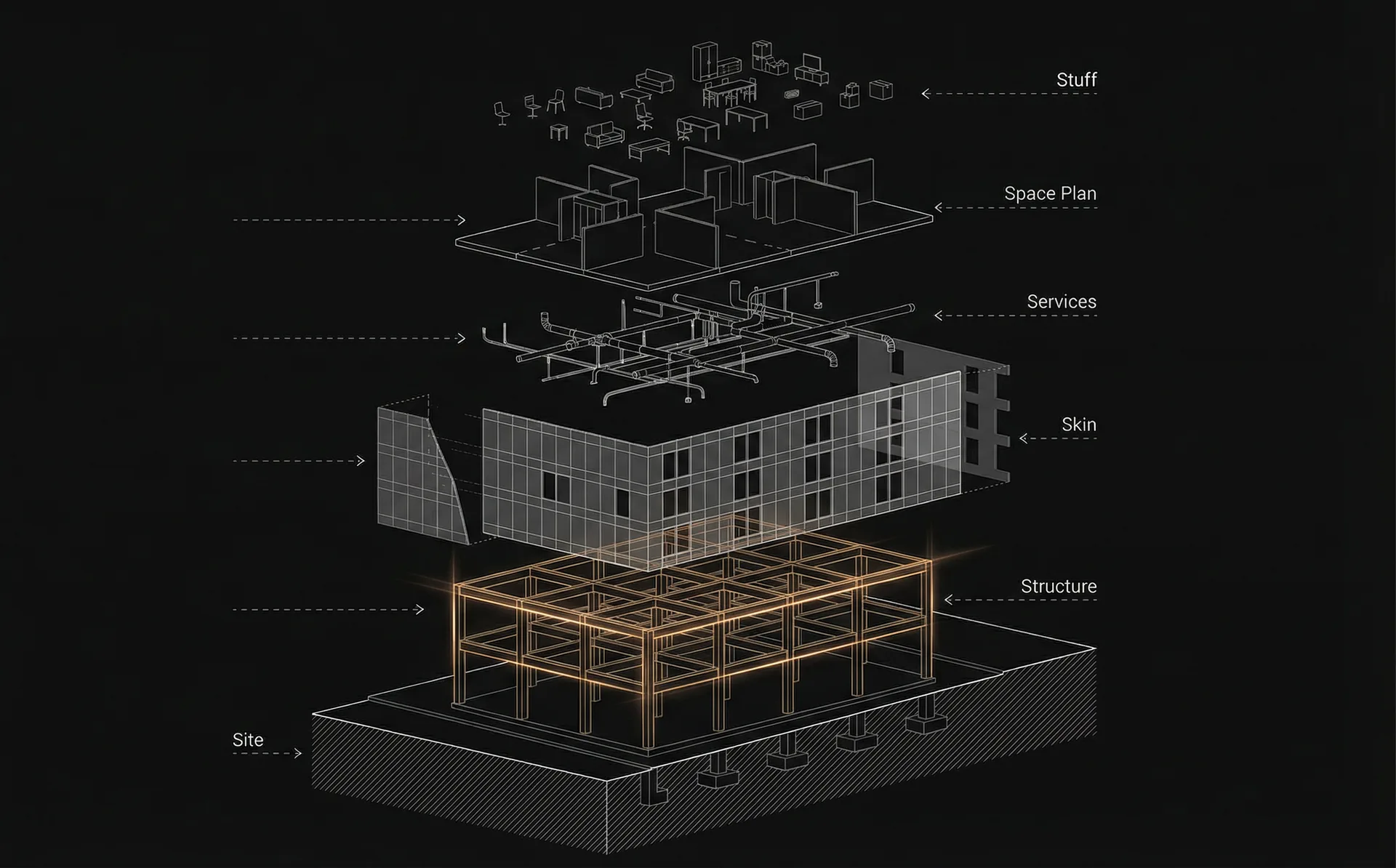
Time is not a dimension we add after design; it is the medium through which architecture exists. Heidegger's Dwelling reminds us that building is always a way of being in the world. Stewart Brand's shearing layers formalize this: site endures for centuries, stuff changes weekly. We design for phased adaptation, disassembly, and operational learning so buildings evolve with time rather than decay against it.
We map every design decision to Brand's six layers: site, structure, skin, services, space plan, stuff. Each layer has a different lifespan. Our buildings are designed so the fast layers can change without destroying the slow ones.
Architecture is not a static object; it is a long event.
We design for what it can become, not only what it is today.
How It All Connects
Computational Roots
Our work is positioned within a specific intellectual lineage, from cybernetic theory to architectural experimentation.
Form & Computation

Frei Otto
1950s–70s · Tensile Structures Form-FindingMunich Olympic Stadium's tensile canopy. Soap film experiments finding minimal surfaces. Otto proved that nature optimizes form through physical constraints, not stylistic preferences.
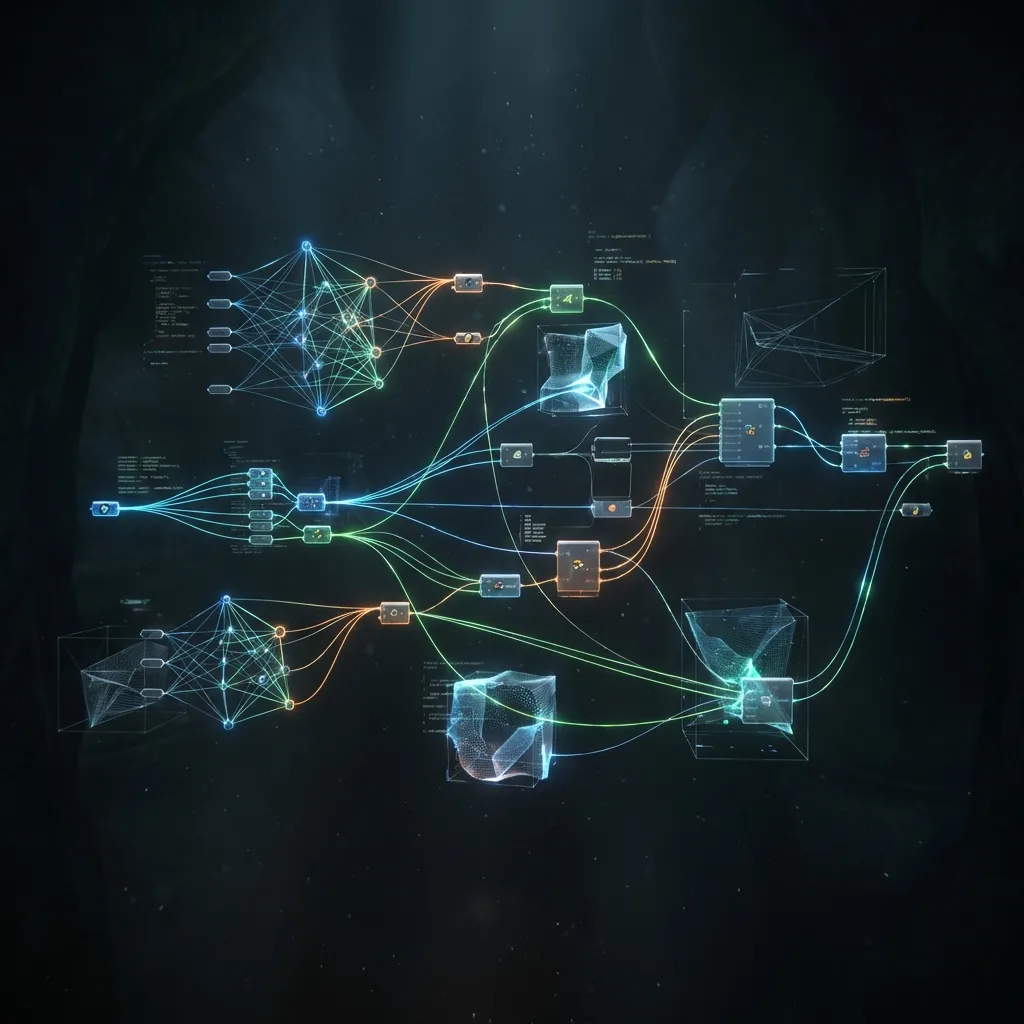
David Rutten
2007– · Visual Programming Grasshopper CreatorBefore Grasshopper, parametric design required programming expertise. Rutten created a visual interface that lets architects think algorithmically without writing code. A design democracy revolution.
Experimental Architecture
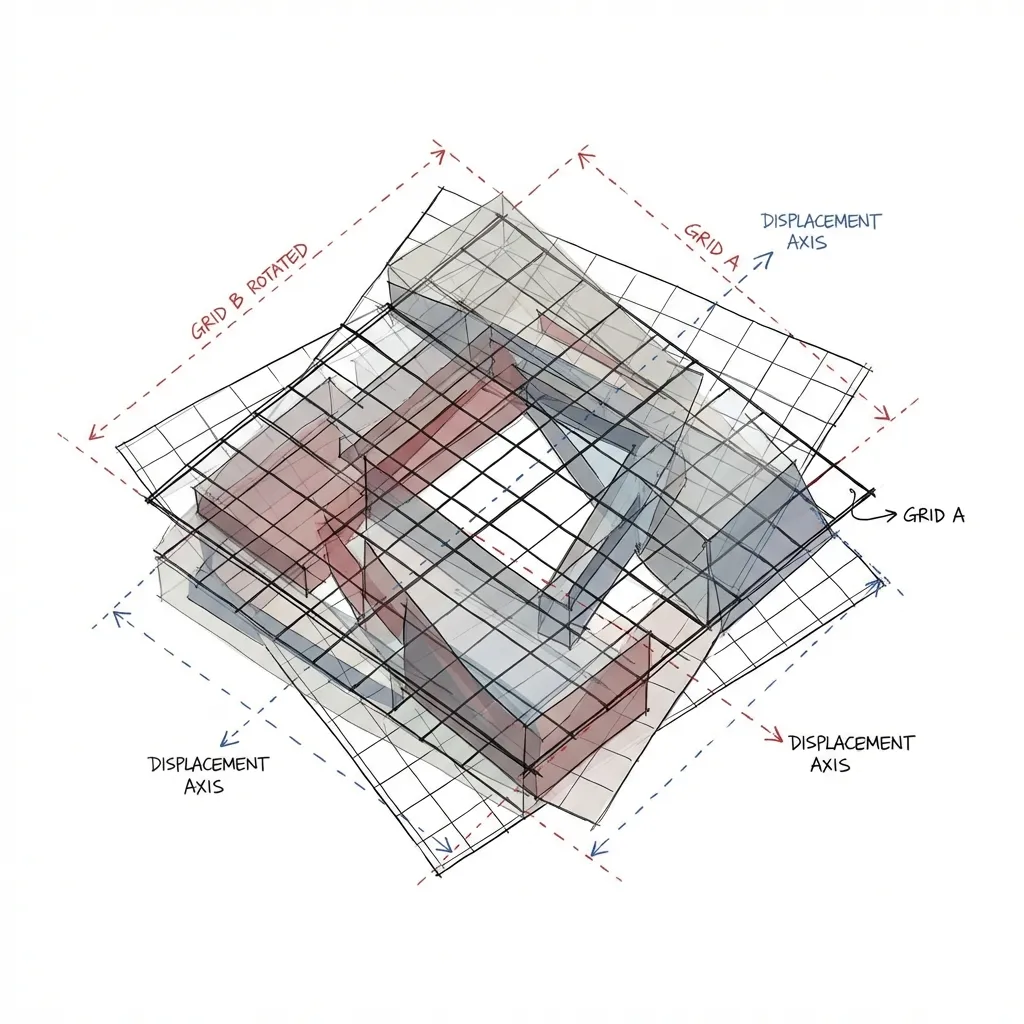
Peter Eisenman
1960s–80s · Formal Experimentation Process & DiagramHouse I through XI: a decade of systematic formal experimentation. Each project explored one rule pushed to its logical conclusion. Eisenman showed that architecture can be a form of research.
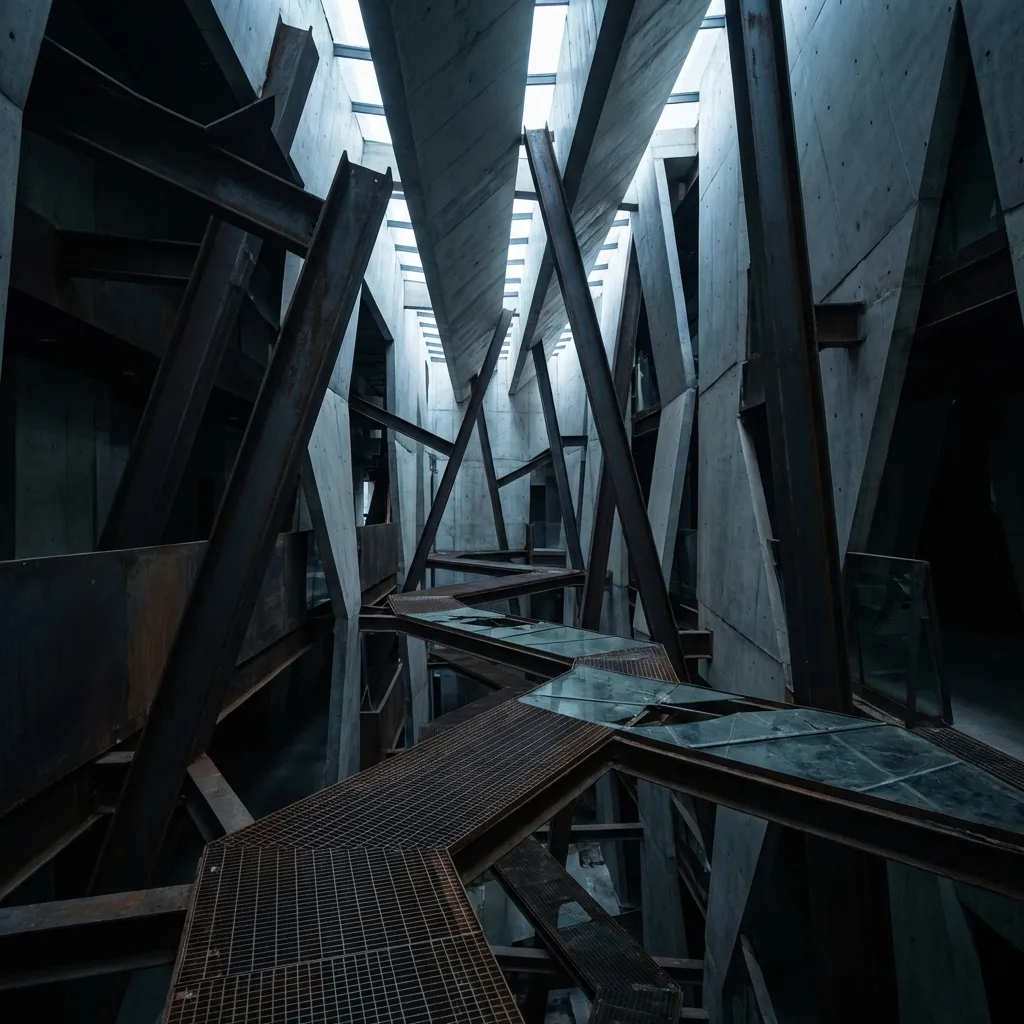
Daniel Libeskind
1989– · Deconstructivism Narrative GeometryArchitecture as storytelling through geometry. The Jewish Museum Berlin (voids, angles, fractures) demonstrates that spatial experience can carry meaning beyond function.

John Hejduk
1960s–90s · Cooper Union Poetic RigorMasques, wall houses, the discipline of reduction. Hejduk's drawings are architecture distilled to its conceptual essence, pure spatial poetry.
Urban Metabolism
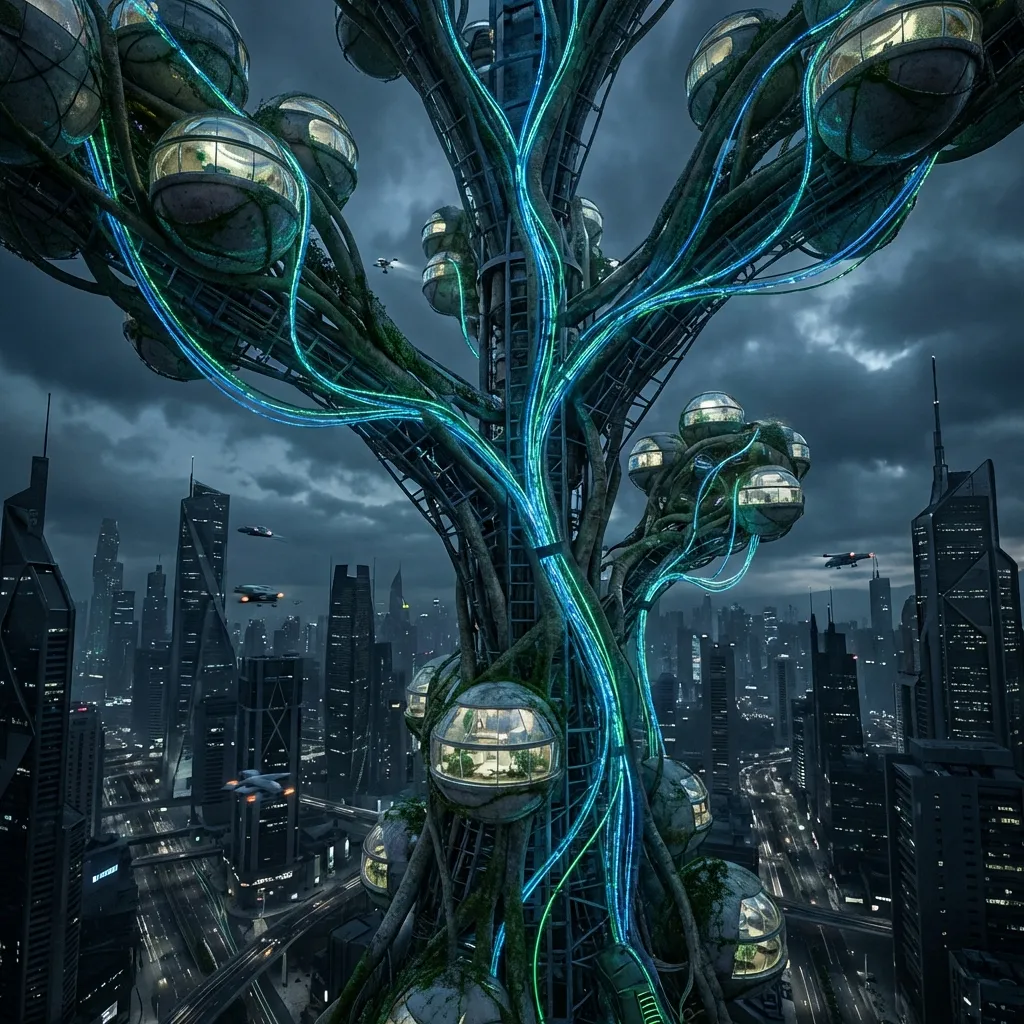
Kenzo Tange
1960 · Tokyo Bay Plan Metabolist Movement1960 Tokyo Bay Plan: infrastructure as tree branches, neighborhoods as cells, city as organism. The Metabolists proposed that urban planning should follow biological, not mechanical, logic.
Rem Koolhaas
1975– · Office for Metropolitan Architecture S,M,L,XLOMA's multi-scale practice spans from furniture to masterplans. S,M,L,XL codified cross-scale thinking: Small, Medium, Large, Extra-Large as a continuous design spectrum where each scale informs the others.

Jan Gehl
1971– · Life Between Buildings Human-Scale Urbanism“Cities for People.” Gehl's pedestrian studies, public space research, and advocacy for walkable urbanism changed how we measure urban quality.
Philosophy & Systems Theory

Deleuze & Guattari
1980 · Post-Structuralist Philosophy A Thousand Plateaus“The Fold” reimagined space as continuous transformation. “A Thousand Plateaus” gave us the Rhizome (non-hierarchical networks that grow in all directions) and the Body without Organs: a field of pure potentiality before organization imposes structure.

Gregory Bateson
1972 · Steps to an Ecology of Mind Mind & NatureCybernetic epistemology: the pattern that connects. Bateson saw mind not as brain, but as the relationship between organism and environment. Ecology of ideas.
Our Approach
Fraktal exists at the intersection of computational precision and architectural intuition.
Data and design go together. We synthesize both. Every project begins with research: environmental simulations, behavioral modeling, parametric exploration. From this foundation of knowledge, form emerges not as arbitrary gesture, but as optimized response.
RESEARCH
We begin with deep Research, collecting data and analyzing precedents to understand the problem space.
SIMULATE
We then Simulate environmental forces, using CFD and solar analysis to inform the geometry.
OPTIMIZE
Algorithms help us Optimize for multiple objectives, evolving thousands of variations to find the fittest solution.
MANIFEST
Finally, we Manifest the design with precise documentation and fabrication-ready data.
The Integrated Model
Conventional practice separates research from production. Universities theorize; offices build. The feedback loop is broken. Fraktal operates differently: as an integrated pipeline of Lab, Studio, and Products.
The Lab generates research. The Studio applies it on commissioned projects, each one a testbed that validates or invalidates a hypothesis. Products encode proven methods into tools. When we solve a problem in the Studio, we extract the logic and build software. Research feeds practice, practice feeds tools, tools feed research. The loop compounds.
Predictive Intelligence
Designs that anticipate future adaptations.
Material Efficiency
Geometry optimized for minimal resource consumption.
Social Resonance
Spaces tuned to human behavioral patterns.
Core Principles
Computational Rigor
Every design decision backed by data. Intuition informed by simulation. We view design not as invention, not as imposing a shape, but as search: finding the form that balances the forces. Like Frei Otto's soap film experiments, we let constraints guide geometry.
Cross-Scale Thinking
From furniture to city. From material to ecosystem. Scale is a spectrum, not a category. A furniture joint informs a structural detail, which shapes a facade, which defines an urban silhouette. Design coherence is scale-invariant.
Adaptive Systems
Buildings that learn. Spaces that respond. Architecture that evolves. We design for reversibility and disassembly, asking not just how a building will be built, but how it will be taken apart in 2080. Static architecture is obsolete architecture.
Open Knowledge
Sharing research, tools, and methodologies. Growing the field together. When we solve a problem, we extract the logic and build a tool, not just file the drawing. Knowledge doesn't accumulate in dusty archives; it lives in the code and the built environment.
Why Now?

The old models are breaking. The 20th-century playbook (zoning separation, car dependence, static construction, fossil-fuel reliance) is physically and economically bankrupt.
Housing Crisis
1.6 billion people will be inadequately housed by 2030. Rising costs and zoning inefficiencies have broken the social contract. We need density that is affordable by design, not by subsidy. The construction industry's negative productivity growth since 1947 tells us the methods, not just the policies, are failing.
Zoning policies originally meant to separate industry from housing now prevent the mixed-use density that makes cities walkable and affordable. Construction productivity has declined because the industry still treats every building as a one-off prototype rather than a systematic, data-informed process.
Climate Infrastructure
70% of existing urban infrastructure will require adaptation by 2050. Our cities are built for a climate that no longer exists. Heat islands, flash floods, and energy volatility are the new baseline. Resilience requires infrastructure that acts as a living buffer, not a static barrier.
Buildings account for 40% of global carbon emissions. Most energy codes optimize individual buildings while ignoring district-level interactions. Heat islands raise cooling demand by 15-25% in dense cores, but the spatial patterns that cause them are predictable and designable.
Mobility Collapse
The car-centric city has reached its mathematical limit. Marchetti's Constant tells us commute times stay fixed while congestion grows. We are moving toward multimodal, decentralized networks where proximity replaces velocity.
The average European city devotes 30-50% of its land to cars. Reclaiming even 10% for pedestrian and cycling infrastructure triggers measurable improvements in local commerce, air quality, and social interaction.
The Fraktal Response
Metabolic Urbanism is not a utopia, it's a necessity. These aren't separate crises; they are symptoms of design thinking that cannot connect scales. We treat the city as an organism, using data to model complex interactions and design interventions that heal rather than just accommodate.
Our Lab quantifies the problems. Our Studio tests solutions on real sites. Our Products encode the validated methods into tools anyone can use. Research, practice, and technology in one feedback loop.
Concept → Form → Build
Question → Simulate → Optimize → Form
“Technology is the answer. But what was the question?”Cedric Price
“The street is the river of life of the city.”William H. Whyte
“Designers are unable to compute with the totality of information... they fall back on familiar patterns, as though the new problem were the old one.”Christopher Alexander
Join the Research
Interested in collaborating on computational design research?
We're always looking for partners, collaborators, and fellow explorers.