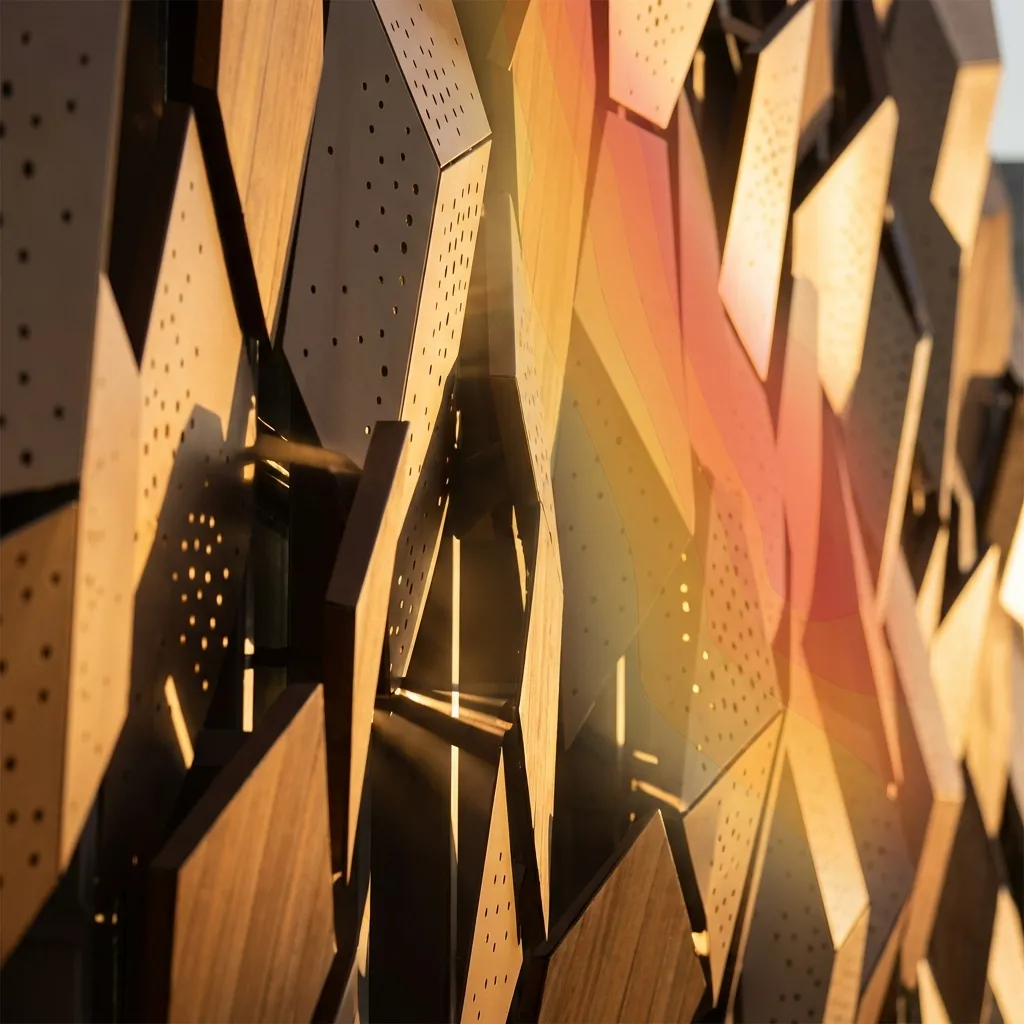
Generative Facades
Every panel optimized for its exact position. 38% less cooling load.
A west-facing glass facade in Istanbul receives 1,420 kWh per square meter per year. That's enough energy to cook an office.
Traditional solutions make you choose. Fixed louvers block sun but kill the view. Tinted glass reduces glare but darkens the interior. You can have comfort or daylight, not both.
We tried something different. What if every panel was optimized for its exact position? South-facing panels are deep. North-facing panels are shallow. West-facing panels have aggressive angles. East-facing panels are gentler.
The result: 38-45% reduction in cooling load while keeping daylight above 50%. That's a combination fixed shading cannot achieve.
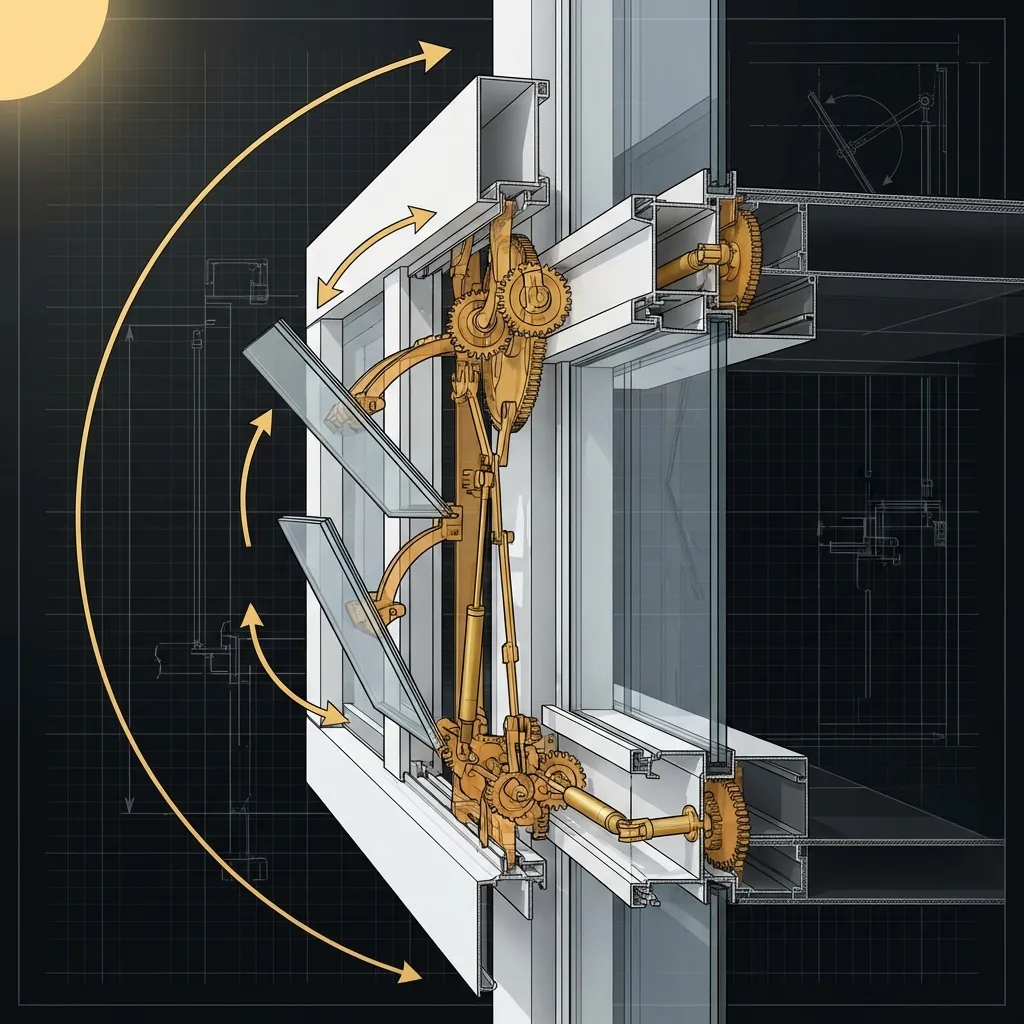
Position-Specific: Each panel responds to its unique solar exposure. The facade is a map of the sun's path.
Theoretical Framework
Solar Performance
38-45% heat gain reduction compared to clear glazing. Each panel does its exact job.
Daylight Balance
Maintaining 50%+ daylight autonomy even with aggressive shading. Comfort and light coexist.
Panel Rationalization
3,472 unique panels clustered into 14 fabrication families. Custom performance, manageable production.
Fabrication Speed
18 seconds per panel on CNC. 60% faster than unclustered approach.
Research Process
Map Solar Exposure
8,760-hour simulation in Radiance, cumulative kWh/m² per zone
Define Parameters
6 variables, 2.3M configurations in the design space
Evolve Solutions
50 generations in Wallacei, Pareto front yields 15-20 optimal options
Rationalize
Cluster 3,472 panels into 14 families for efficient CNC fabrication
Research Phases
Environmental Mapping
8,760 hours of solar simulation using Radiance. Cumulative radiation mapped per facade zone.
Design Space
6 parametric variables generating 2.3 million valid panel configurations. The space is vast.
Evolution
50 generations, 100 panels per generation. Wallacei breeds toward Pareto-optimal solutions.
Fabrication
Clustering algorithm groups similar panels. CNC toolpath generation for robotic fabrication.
Key Metrics
Key Thinkers
Mike Davies
In 1981, Davies imagined a wall that could filter heat, light, air, and view independently. We're finally building it, forty years later.
Klaus Daniels
Daniels wrote the book on climate-responsive facades. Our simulation methods extend his performance modeling.
Frei Otto
Otto minimized material through form. We minimize energy through geometry. Same philosophy, different medium.
Jan Knippers
Knippers leads biomimetic facade research. Our panel articulation draws from his work on adaptive structures.
Case Studies
Bilkent Office Tower
Ankara, TurkeyWest-facing curtain wall with optimized aluminum louvers. First full-scale implementation . 38% cooling reduction confirmed.
Mediterranean Pavilion
Izmir, TurkeyETFE cushion prototype with variable pneumatic fill. 42% heat reduction. Testing ground for lightweight materials.
Athens Embassy Retrofit
Athens, GreeceHeritage-sensitive secondary skin on existing stone facade. 45% cooling reduction without altering the historic exterior.
Comparative Analysis
Fixed Louvers
One Angle Fits AllStatic aluminum blades at fixed angle. Works on one orientation, fails on others.
Kinetic Facades
Moving PartsPanels that track the sun. High performance, very high maintenance. Al-Bahar Towers style.
Parametric Panels
Smooth VariationGradual geometric change across the surface. Visually striking, not necessarily optimized.
Our Approach
Per-Panel OptimizationEach panel evolved for its specific conditions. Best performance-to-cost ratio we've achieved.
Optimization Results
Percentage reduction compared to clear glazing
Key Findings
Self-shading cuts cooling 38-45% in Mediterranean climates. Istanbul, Izmir, Athens all confirmed.
38-45% reductionOptimal panel depth varies from 120mm (north) to 480mm (west) on a single building. Uniform shading wastes material.
4× depth variationVoronoi perforation achieves 23% higher daylight uniformity than regular grids at the same openness ratio.
+23% uniformityTopology optimization of panel geometry reduces aluminum usage by 23% without compromising strength.
23% material savedHonest Limitations
Variable angles collect dust unevenly. Maintenance is harder than uniform systems.
Glare risk. Some configurations redirect light into eyes rather than blocking it.
Cost premium. 12-18% higher fabrication cost versus standard curtain wall.
Winter penalty. Aggressive shading reduces beneficial solar gain in cold climates.
Conclusion
Every panel can be different and still be buildable. With per-position optimization, we achieve 38-45% cooling reduction while maintaining daylight above 50%. That's a performance level fixed shading cannot reach. The method works. We've built it.
Limitations
- Maintenance complexity
- 12-18% cost premium
Future Directions
- Real-time solar tracking
- Self-cleaning surface research