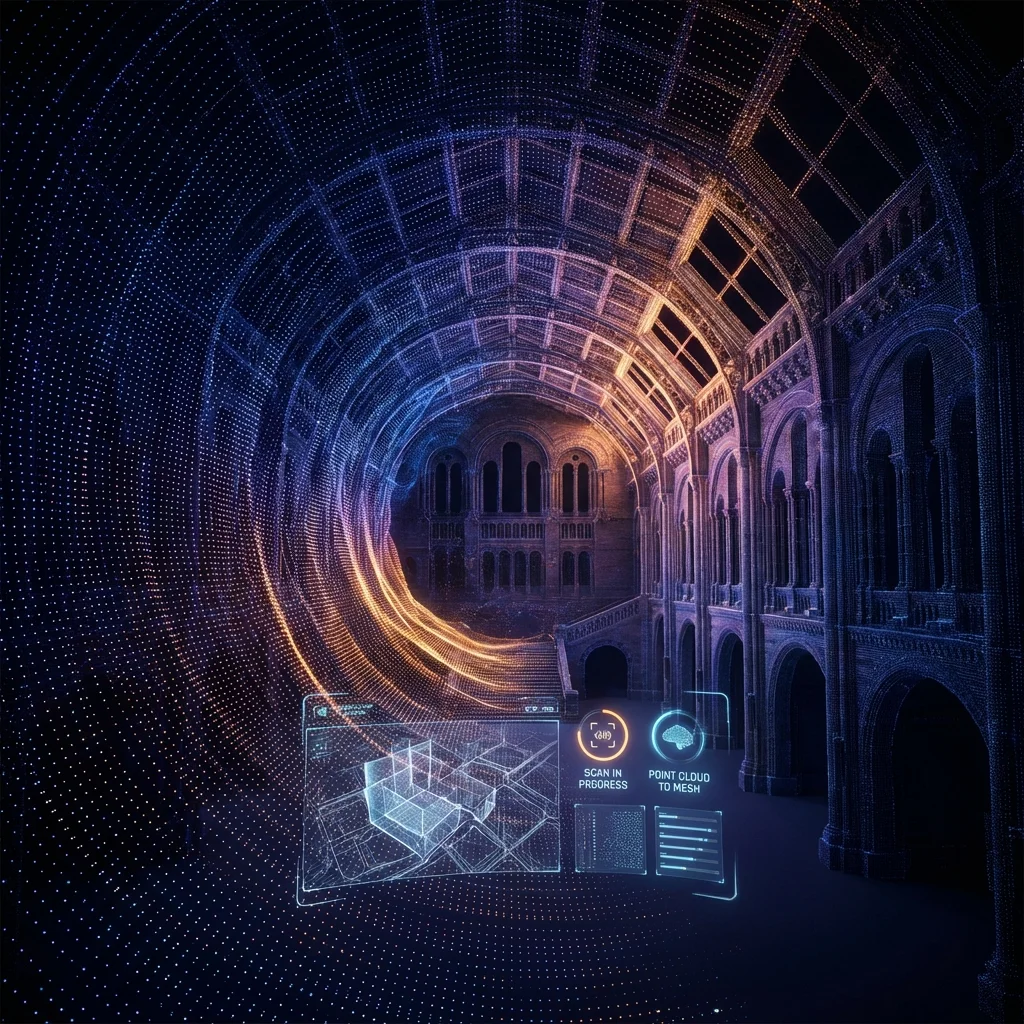
Spatial Computing
What if clients could walk through buildings before we build them?
Every architect knows this conversation: 'I thought this room would feel bigger.'
It happens after the walls are up. After the money is spent. The client approved floor plans they didn't really understand. Now they're disappointed. Change orders follow. Trust breaks.
The problem isn't the design. It's the communication medium. Floor plans are abstractions. Even 3D renders on a screen don't convey scale. You can't feel a room from a picture.
So we built a different workflow. LiDAR scans existing conditions in 30 minutes. VR lets clients walk through proposed designs at 1:1 scale. AR overlays new walls on existing spaces during construction. The result: clients who understand what they're approving.
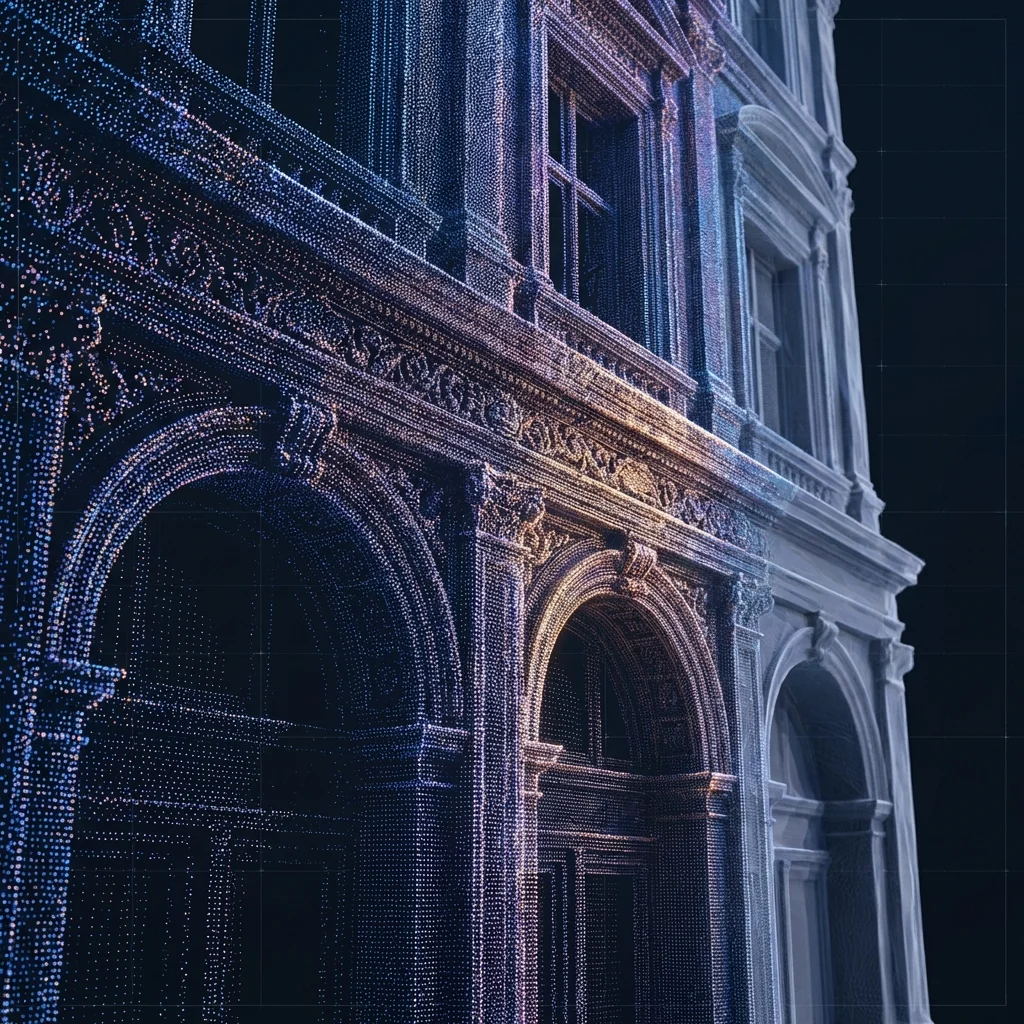
30 Minutes to Complete Model: 2.1 million points captured. Replaces a 2-day manual survey with millimeter accuracy.
Theoretical Framework
LiDAR Capture
30-minute scans for 60m² spaces. iPhone Pro for residential, Leica for precision. Replaces 2-day manual surveys.
VR Review
1:1 scale client walkthroughs. Quest 3 for accessibility, Vision Pro for quality. Clients feel the space.
AR Verification
On-site overlay of digital model. Contractors see clash zones before they become problems.
72% Change Reduction
Spatial miscommunication dropped from 28% to 8%. Clients approve designs they actually understand.
Research Process
Scan with LiDAR
iPhone Pro captures 800K-2M points in 15-25 minutes at ±2cm accuracy
Build VR Environment
Point cloud to Unity via Rhino.Inside, 4-6 hours for low-poly spatial model
Client VR Session
1:1 walkthrough with sticky notes and furniture testing, 45-60 minutes
AR Site Verification
Overlay model on construction to catch discrepancies early
Research Phases
Technology Benchmarking
Tested iPhone Pro, Matterport, and Leica for accuracy versus speed tradeoffs at residential scale.
VR Pipeline
Point cloud to Unity workflow with Rhino.Inside. Optimized for spatial accuracy, not photorealism.
Client Testing
24 renovation projects in Istanbul with A/B testing: screen review versus VR review.
SpaceCraft App
Commercial iOS app integrating capture, review, and client collaboration in one tool.
Key Metrics
Key Thinkers
Jaron Lanier
Lanier coined 'virtual reality' and built the first commercial systems. Our client-facing VR inherits his vision of experiential computing.
Apple Vision Pro Team
Apple defined 'spatial computing' as mainstream. Our RealityKit integration follows their architectural decisions.
Greg Lynn
Lynn pioneered computational design in architecture. Our parametric-to-VR pipeline extends his workflows.
James Turrell
Turrell's installations explore how humans perceive space. We prioritize perceptual accuracy over photorealism.
Case Studies
Kadikoy Apartment
Istanbul, TurkeyClient walked through proposed open kitchen 3 times in VR before approving wall demolition. Zero change orders during construction.
Nisantasi Boutique Hotel
Istanbul, TurkeyHeritage building documented with LiDAR for renovation feasibility. Traditional survey would have taken 2 weeks.
Ulus Private Villa
Ankara, TurkeyRemote client in Dubai reviewed villa design in VR. Final approval without ever visiting the site in person.
Comparative Analysis
LiDAR Scanning
30 Minutes to ModeliPhone Pro or professional scanner. Millimeter accuracy. Replaces tape measures and laser distance finders.
VR Immersion
Walk Through Before Build1:1 scale walkthrough on Quest 3 or Vision Pro. Clients experience space, not just see it.
AR Verification
On-Site OverlayDigital model projected onto construction site. Catches discrepancies before finishes go in.
Digital Twin
Living DocumentContinuously updated model from scan + design + feedback. Single source of truth throughout project.
Optimization Results
Percentage of projects with 'I thought it would feel different' feedback
Key Findings
VR crushes spatial miscommunication. Change orders dropped from 28% to 8% when clients reviewed in VR instead of on screen.
72% reductionDecision speed doubles. Average time-to-approval: 4.2 weeks with 2D, 2.1 weeks with VR.
2× fasterLiDAR saves days. Traditional survey takes 1-2 days. SpaceCraft scan takes under an hour.
80% fasterAR catches problems. 90% of on-site conflicts detected in AR overlay before they became expensive fixes.
90% caught earlyHonest Limitations
Sample size. 24 projects is enough to see patterns, not enough for statistical certainty.
Renovation bias. 22 of 24 projects were renovations. New construction is under-represented.
Low-poly only. We tested spatial VR, not photorealistic. Does visual fidelity matter? We don't know.
Istanbul only. Cultural factors in client behavior may not generalize.
Conclusion
Clients don't misunderstand VR. When they walk through a design at 1:1 scale, they know what they're approving. Change orders drop 72%. Decisions happen twice as fast. LiDAR surveys that took days now take an hour. This isn't future tech. It's how we work now.
Limitations
- Small sample size
- Renovation focus
Future Directions
- Photorealistic VR comparison
- Cross-cultural validation