
Garden City Revisited
Howard was right about infrastructure. He was wrong about geometry.
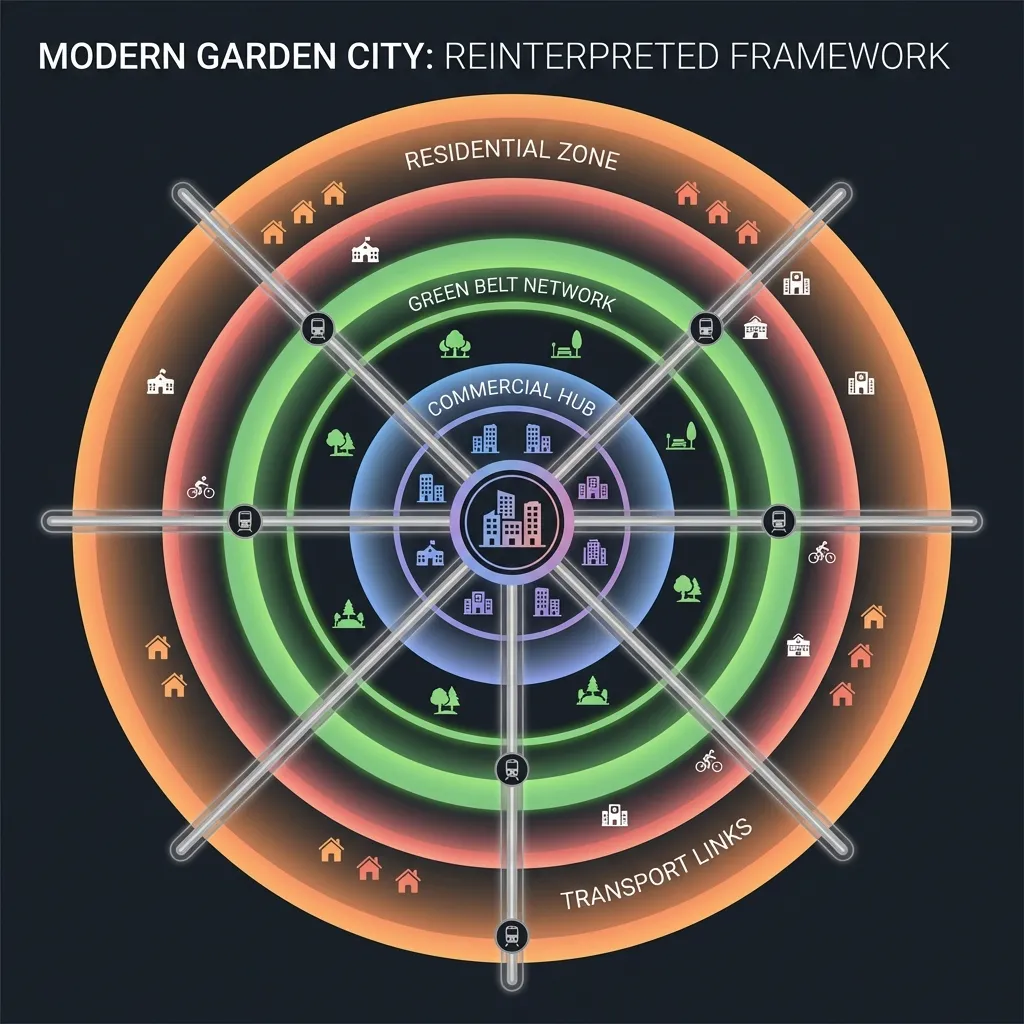
In 1898, Ebenezer Howard published a diagram that changed cities forever. Concentric rings: park at the center, civic buildings around it, housing beyond, industry further out, farmland at the edge. Self-sufficient, walkable, green.
But Howard's rings are rigid. Hierarchical. Top-down. They work on flat land with compliant citizens. What about hillsides? What about cultures that don't like grids?
Look at Zermatt. No masterplan, yet everyone knows where they are. Streets follow the mountain. Public spaces emerged from centuries of use. It's not planned, but it works.
Can we combine these? Radial infrastructure for legibility. Organic grain for humanity. That's what this research tested.
Tree vs. Rhizome: Left: Howard's concentric rings. Right: Alpine village following terrain. Both work. Why not combine them?
Theoretical Framework
Howard's Radial Model
Concentric zones from park to farmland. Top-down, hierarchical, geometric. Works on flat land.
Alpine Organic Model
Streets follow contours. Spaces emerge from use. Bottom-up, topographic, adaptive.
Lefebvre's Production of Space
Space is socially produced, not just geometrically defined. We evaluate by social outcomes, not plan beauty.
Deleuze's Rhizome
Networks with multiple entry points beat hierarchies with single centers. Gardens can be forests.
Research Process
Case Study Analysis
8 Garden Cities mapped across 4 countries, 24 districts analyzed
Typology Extraction
16 hybrid district models identified from synthesis
TFI Measurement
Topographic Fit Index developed and validated
Performance Testing
Walkability, retail viability, infrastructure costs measured
Research Phases
Historical Analysis
Mapped 8 Garden City implementations across UK, Switzerland, Finland, Japan, and Turkey.
Morphological Comparison
GIS overlays of planned vs. organic settlements. Figure-ground studies at consistent scales.
TFI Development
Created Topographic Fit Index: a quantitative measure of how well urban form responds to terrain.
Hybrid Prototyping
Generated 16 neighborhood typologies combining radial infrastructure with organic grain.
Key Metrics
Key Thinkers
Ebenezer Howard
Howard was a stenographer, not an architect. Yet his 1898 book shaped 20th-century cities. His core insight: infrastructure first, buildings second. We kept that. We revised the geometry.
Henri Lefebvre
Lefebvre showed that space is a social product. Planning creates social outcomes, not just geometric ones. We evaluate by walkability and identity, not by plan elegance.
Deleuze and Guattari
Their 'tree vs. rhizome' distinction maps perfectly to Howard vs. Zermatt. We're not anti-tree. We're pro-hybrid.
Alpine Vernacular Builders
Mountain villages grew without plans. Streets follow contours. Spaces come from labor. Organic doesn't mean random. It means responsive.
Case Studies
Letchworth, UK
Hertfordshire, EnglandThe first Garden City. Howard's prototype. Radial infrastructure works, but the plan ignores terrain. Flat sites only.
Zermatt, Switzerland
Valais CantonNo masterplan, yet highly legible. Streets follow terrain. Public spaces emerged from centuries of use. High social cohesion.
Tapiola, Finland
Espoo, near HelsinkiFinnish Garden City with forest integration. Stronger nature penetration than Howard's original. Nordic interpretation.
Comparative Analysis
Letchworth (1903)
The OriginalHoward's prototype. Radial plan, 32,000 population cap. Excellent green belt, but ignores terrain completely.
Zermatt
Alpine VernacularNo masterplan. Streets follow terrain. Public spaces emerged from centuries of collective use. Surprisingly legible.
Tapiola (1952)
The Forest CityFinnish Garden City variant. Forest-integrated housing clusters. Stronger nature penetration than Howard imagined.
Fraktal Hybrid
Our ProposalRadial infrastructure for legibility. Organic grain for humanity. Best of both approaches.
Optimization Results
How well does the urban form follow the land?
Key Findings
Hybrid infrastructure works. Secondary rhizomatic connections increased walkability by 27% without killing the radial backbone's legibility.
+27% walkabilityPolycentric beats monocentric. Districts with 3-5 micro-centers showed 34% higher retail viability than single-center plans.
+34% retailTerrain response is measurable. High-TFI settlements showed 40% lower infrastructure costs and stronger community identity.
-40% infra costHoward was half right. Infrastructure-first works. Concentric rings don't have to.
Proven principleHonest Limitations
Four countries only. UK, Swiss, Finnish, Turkish examples may not transfer globally.
Greenfield bias. Howard assumed new development. Infill is different.
TFI validation ongoing. The 40% cost reduction claim needs more cases.
Community identity is hard to measure. Our correlation may hide confounders.
Conclusion
Howard's Garden City got infrastructure right and geometry wrong. Alpine villages got geometry right and scale wrong. Combine them: radial backbone for legibility, organic grain for humanity. The result is 27% better walkability, 34% better retail, and 40% lower infrastructure costs.
Limitations
- Four-country sample
- Greenfield focus
Future Directions
- Urban infill adaptation
- Broader TFI validation