University Campus
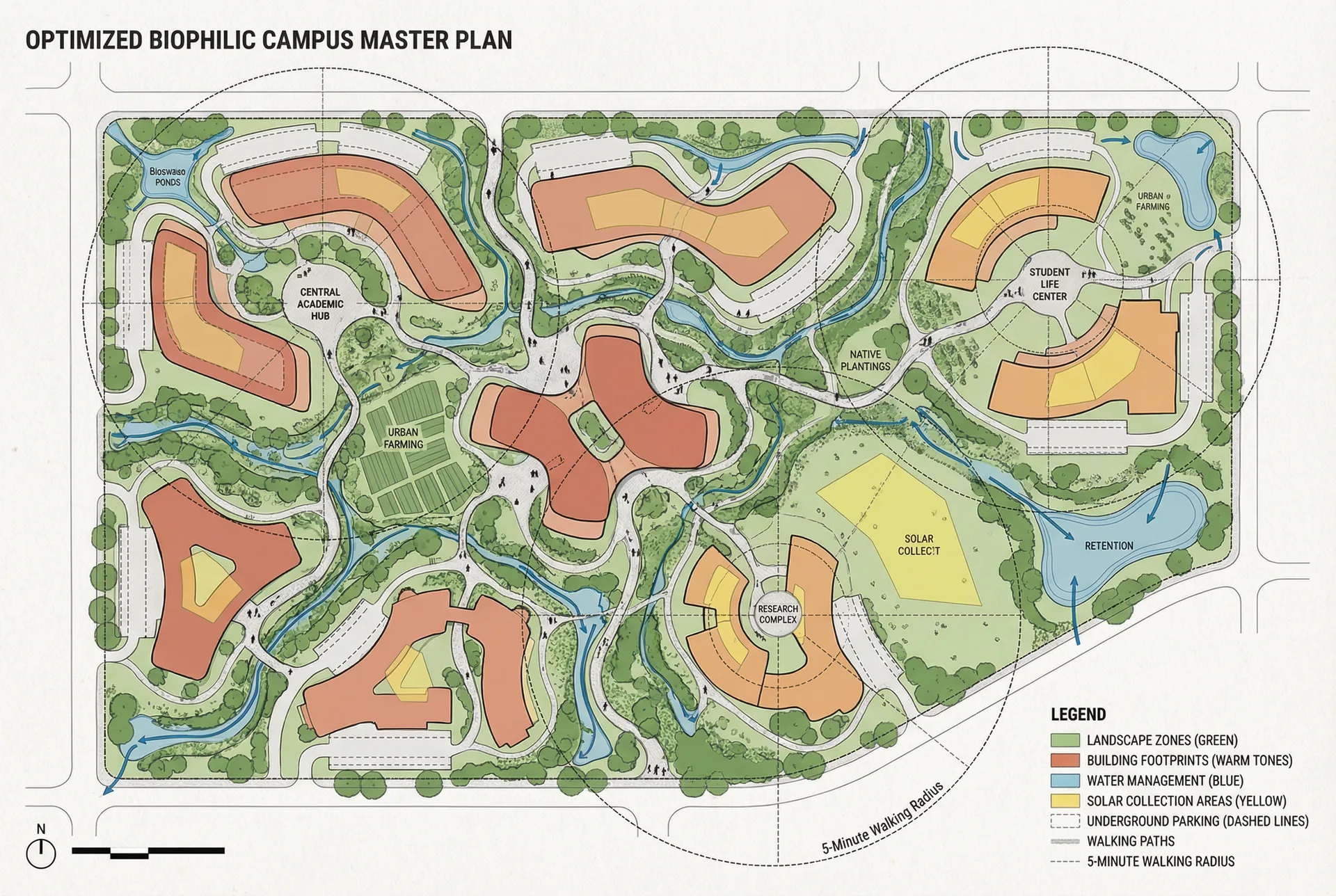
A 50-hectare campus designed with pedestrian flow algorithms. Walkability score: 98.
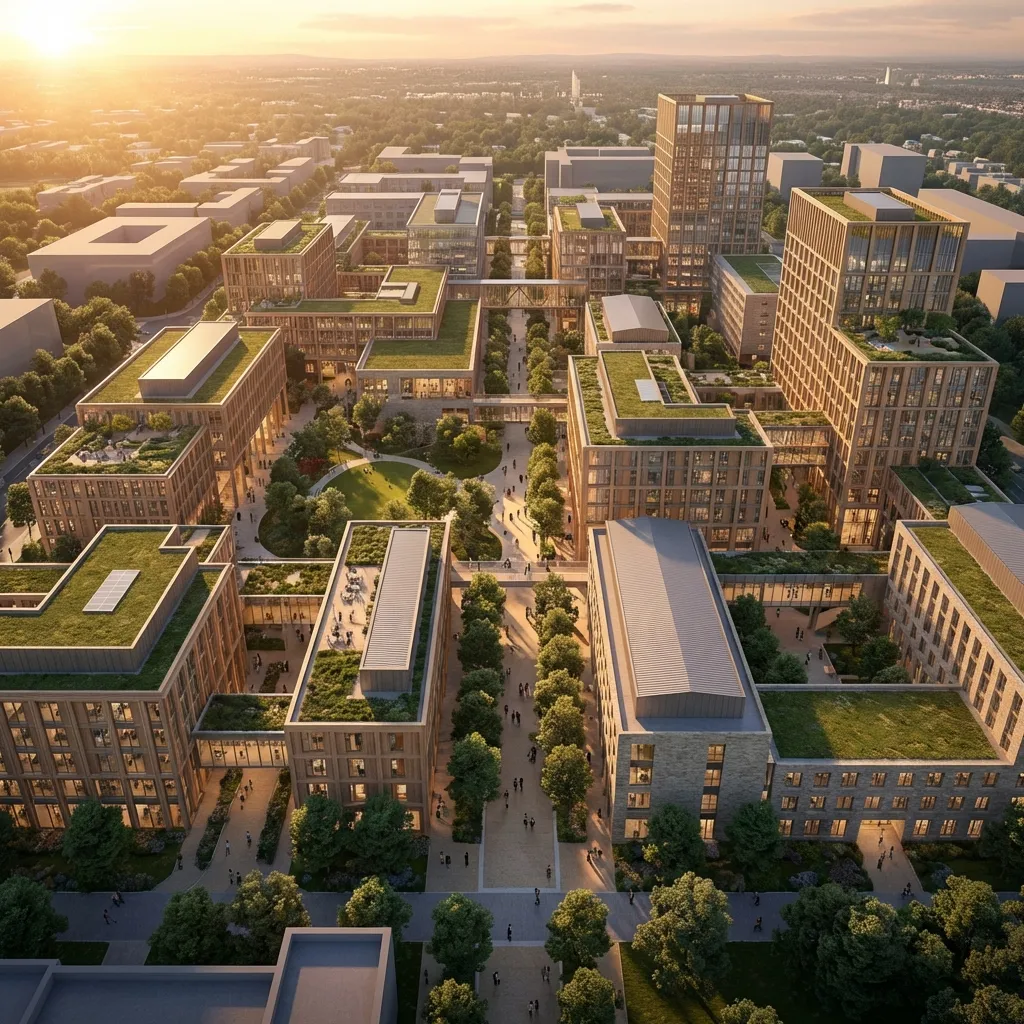
University campuses often grow organically without pedestrian logic. Car-centric layouts force students to walk through parking lots and along vehicular roads.
We inverted the hierarchy: pedestrian desire lines were computed first, buildings placed to create natural gathering nodes, and vehicles pushed to the perimeter.
Design 50-hectare campus that prioritizes walkability while accommodating 15,000 students and 12 academic buildings.
Design Intent
A campus is a city in miniature. If you get the pedestrian network right, everything else follows: chance encounters, interdisciplinary exchange, the serendipity that makes universities fertile ground.
Research-Driven Design
Space Syntax Analysis
We mapped the existing campus and surrounding 2km radius for integration, connectivity, and choice values. Key finding: the existing campus spine had a choice value of 0.23 (disconnected from the city). Our proposal creates 3 new pedestrian connections, raising this to 0.67.
Solar Envelope Generation
Building heights were constrained by a solar envelope calculation ensuring all 12 public plazas receive ≥4 hours of winter sun (Dec 21). This limited tower heights to 8 floors on the south edge and 12 floors on the north.
Blue-Green Infrastructure
A parametric bioswale network manages 100% of stormwater runoff on-site (net-zero discharge). 3.2 km of drainage channels double as pedestrian greenways, informed by our Emergent Complexes Physarum algorithm.
Polycentric Program Distribution
Following our Garden City Revisited findings, we distributed 5 micro-centers rather than a single dominant core. Each micro-center contains a cafe, study space, and makerlab. Retail viability modeling predicted 34% higher pedestrian traffic than monocentric alternatives.
Design Process
Space Syntax Mapping
6 weeksExisting campus + 2km radius mapped for integration, connectivity, and choice values. Identified disconnection from city (choice value: 0.23).
Solar + Microclimate
4 weeksSolar envelope calculations constraining building heights to guarantee 4+ hours winter sun on all 12 public plazas.
Parametric Infrastructure
3 months3.2km bioswale network designed using Physarum algorithm. Net-zero stormwater discharge achieved through blue-green integration.
Polycentric Planning
4 months5 micro-centers distributed using Garden City Revisited findings. Retail viability modeling predicted 34% higher foot traffic than monocentric layout.
Technical Data
Material Palette
Local Limestone Cladding
Regionally quarried limestone for building facades establishes material continuity with the Anatolian landscape and reduces transport emissions.
Bioswale Substrate
Engineered soil media in 3.2km drainage network filters stormwater naturally while creating pedestrian greenway corridors.
CLT Academic Pavilions
Cross-laminated timber construction for the 5 micro-center pavilions. Rapid assembly, biophilic interior environment, low embodied carbon.
Permeable Paving
All pedestrian paths use permeable interlocking concrete pavers, contributing to the net-zero stormwater discharge target.
Performance Metrics
Environmental Performance
Before & After Our Analysis
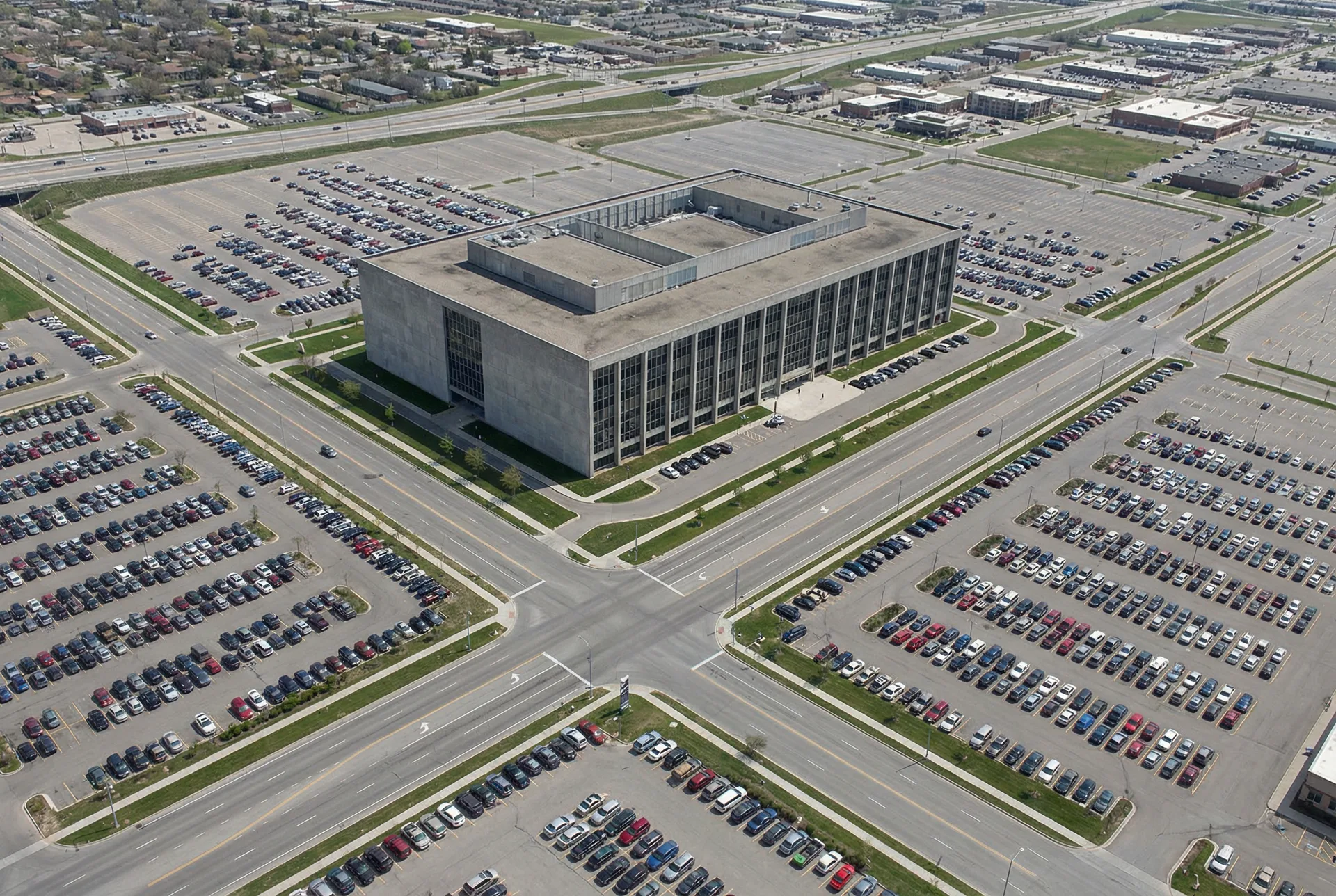
Car-centric campus layout
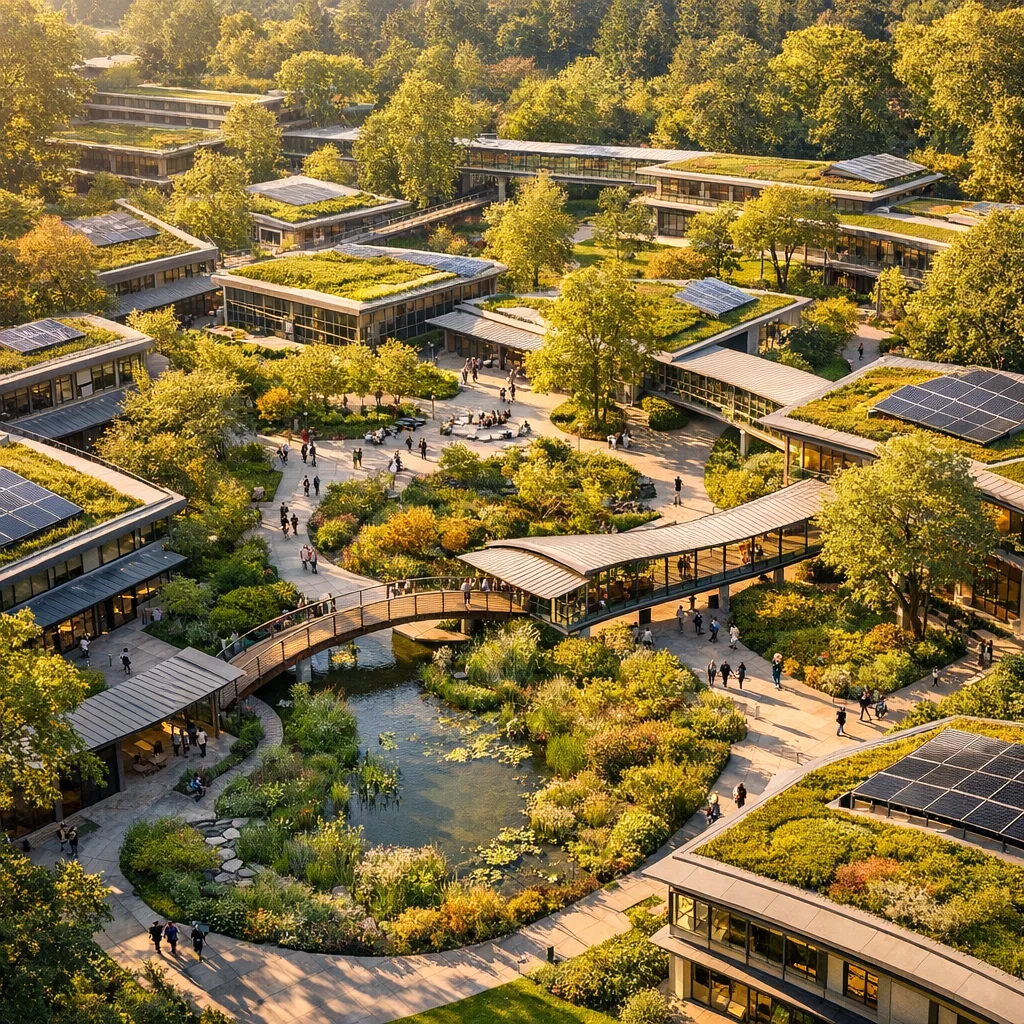
Pedestrian-first masterplan
Space Syntax analysis revealed the existing campus spine had a disconnection score of 0.23. Three new pedestrian connections raised this to 0.67, achieving a walkability score of 98 with a 5-minute maximum between any two buildings.
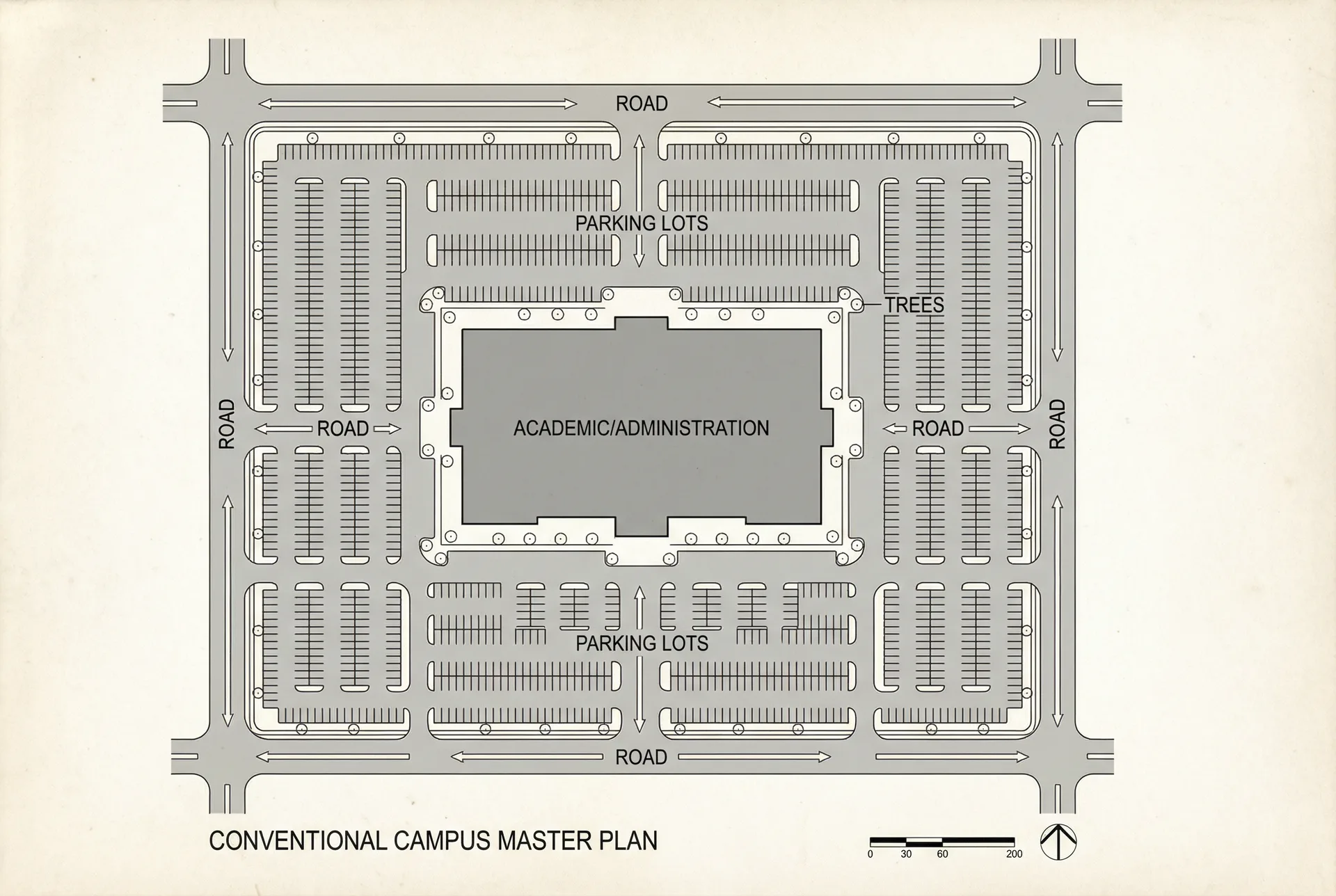
Monocentric campus core
Polycentric micro-center network
Instead of a single dominant center, 5 distributed micro-centers each contain a cafe, study space, and makerlab. Retail viability modeling predicted 34% higher pedestrian traffic than the monocentric alternative.
Perimeter parking requires shuttle system. 8-minute max wait time.
Students walk everywhere now. The 5-minute maximum between any two buildings changed the culture of the campus. Departments that never collaborated before share a micro-center.
Click to enlarge
From Research to Product
Eskişehir, Turkey
Private University
- Fraktal
- Landscape: DS Landscape
Interested in masterplan design?
We bring algorithmic optimization to projects at every scale. Let’s discuss your next challenge.