
Adaptive Domesticity
Why does a Tokyo apartment feel different from a Paris one? We measured.
Walk into a Tokyo apartment. The kitchen flows into the living room. No door, no threshold. It feels open, almost exposed.
Walk into a Paris apartment. The kitchen hides behind a door. Always. The salon is for guests; the kitchen is for work. They don't mix.
Walk into an Istanbul apartment. There's a formal salon for guests, completely separate from the family living room. Two worlds under one roof.
Why? These aren't random preferences. They're cultural patterns encoded in space. Privacy gradients. Hospitality protocols. Rules about who sees what. We set out to measure them.
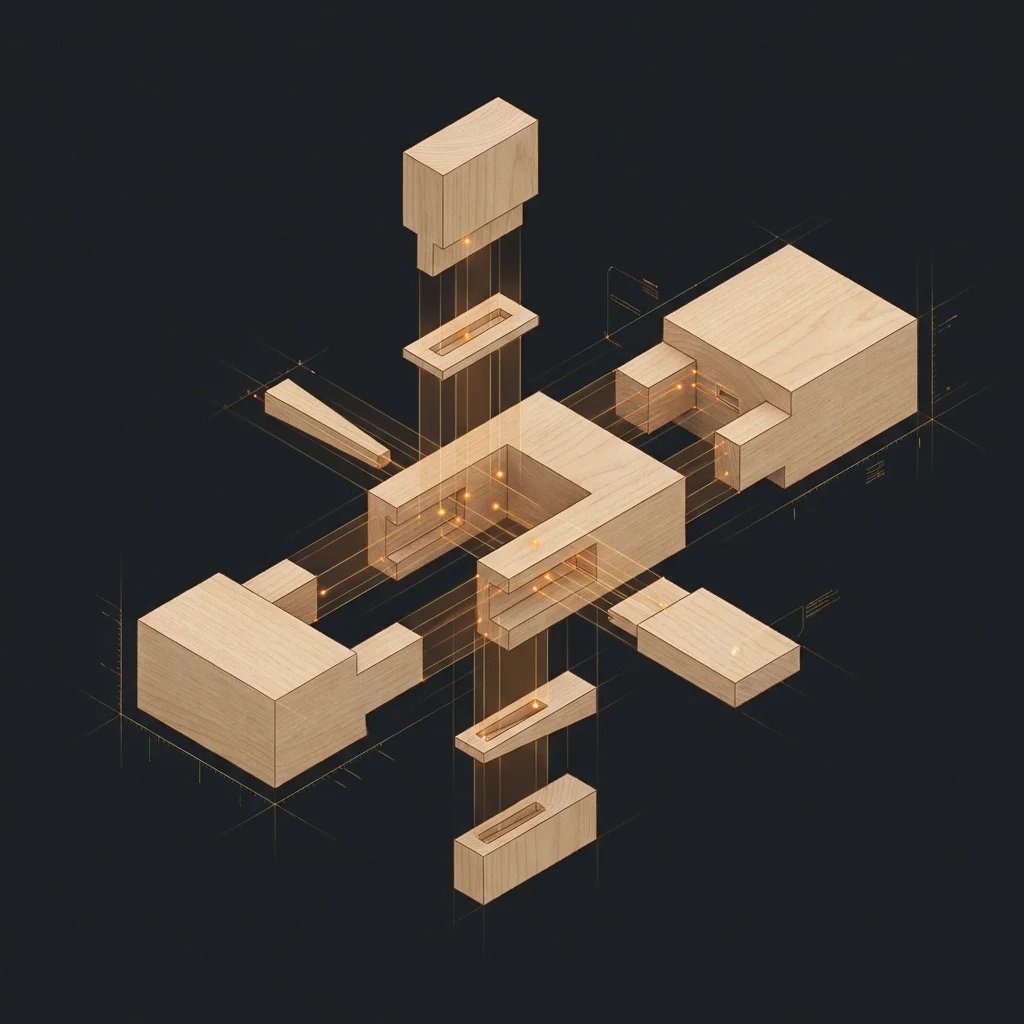
Furniture as Evidence: Joint complexity predicts spatial hierarchy. Complex joinery correlates with more threshold conditions.
Theoretical Framework
Furniture Scale
3,200 pieces photographed and measured. Joint typologies reveal cultural attitudes toward craftsmanship and material.
Room Scale
47 apartments tracked over 6 months. LiDAR and depth cameras documented daily routines.
Typology Scale
856 floor plans from 1920 to 2024. Machine learning extracted room adjacencies, circulation patterns, privacy gradients.
Cultural Synthesis
All three scales feed into a pattern database. Products like SpaceCraft use this data.
Research Process
Document Furniture
Computer vision analysis of 3,200 pieces from 8 cultural regions
Track Occupancy
47 apartments observed with LiDAR and depth cameras
Analyze Plans
856 floor plans processed with ML for pattern extraction
Synthesize Patterns
Cultural typology database for product integration
Research Phases
Furniture Documentation
Computer vision analysis of 3,200 pieces from 8 regions. Joint typologies, material transitions, proportion systems.
Occupancy Tracking
47 families let us install cameras. Six months of morning routines, evening gatherings, sleeping transitions.
Floor Plan Analysis
856 plans from a century of housing. ML extracts adjacencies, proportions, circulation hierarchies.
Product Integration
Cultural pattern database powers SpaceCraft scanner.
Key Metrics
Key Thinkers
Gottfried Semper
Semper argued that architecture begins with textile weaving and furniture joinery, not monumental form. We took him literally and started measuring furniture joints.
Gaston Bachelard
The Poetics of Space taught us that houses are emotional, not just geometric. Corners protect us. Attics dream. Cellars store fears. Our research tries to measure what Bachelard described.
Junichiro Tanizaki
In Praise of Shadows explains why Japanese spaces value penumbra while Western spaces chase illumination. There's no universal 'good design.' There are cultural grammars.
Edward T. Hall
Hall invented proxemics: the study of human spatial relationships. Comfortable distances vary by culture. Our privacy gradient metrics extend his work.
Case Studies
Tokyo Compact Living
Shibuya, Tokyo32 square meters with no doors between living spaces. Privacy through ritual, not walls. Morning routines are choreographed to avoid collision.
Paris Haussmann Apartment
6th Arrondissement, ParisClassic bourgeois layout. Kitchen hidden from salon. Service corridor for staff. 95 square meters with 4 distinct threshold conditions.
Istanbul Multi-Generational
Kadikoy, IstanbulGuest salon completely isolated from family living. Grandmother has her own entrance. Hospitality and intimacy don't share space.
Comparative Analysis
Tokyo
The Flowing SpaceNo doors between living areas. Privacy through ritual, not walls. Kitchen is the social center.
Paris
The Hidden KitchenKitchen always separate. Service and served spaces don't mix. Guests see the salon, not the mess.
Istanbul
The Guest SalonTwo living rooms: one for family, one for guests. Hospitality has its own architecture.
Marrakech
The Courtyard HomeBlank exterior, rich interior. All rooms face the central court. Maximum privacy from street.
Optimization Results
How many thresholds between street and most private room?
Key Findings
Furniture joints predict spatial hierarchy. Cultures with complex joinery (Japan, Scandinavia) have more nuanced room transitions.
0.73 correlationTurkish apartments have 2.3 times more 'buffer zones' than Tokyo apartments. Hospitality protocols are encoded in circulation.
2.3× more buffersParisian kitchens are 40% smaller than Tokyo kitchens in same-sized apartments. Privacy gradient trumps cooking space.
40% size differenceMorning routines in Istanbul start 25 minutes later than Tokyo. Urban rhythm shapes domestic choreography.
25 min offsetHonest Limitations
47 apartments is a small sample. We see patterns, not statistical proof.
All apartments were middle-class urban. We can't claim this applies to social housing or luxury.
Cameras change behavior. 'Natural' routines might be performances.
1920s floor plans versus 2024 occupancy. Building stock evolved faster than our analysis.
Conclusion
Domestic space encodes culture. The way a door is positioned, where the kitchen sits, how many thresholds separate street from bedroom: these aren't random choices. They're cultural grammars. We can measure them, compare them, and design with them.
Limitations
- Small sample size
- Middle-class focus
Future Directions
- Expand to social housing
- Real-time occupancy API